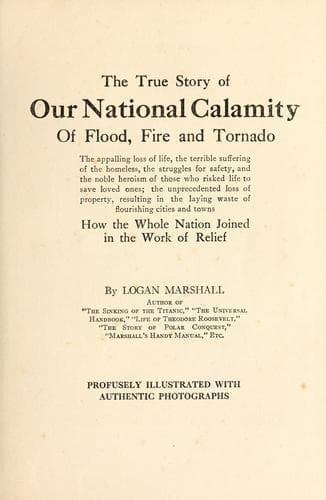
The True Story of Our National Calamity of Flood, Fire and TornadoMarshall, Logan
History
The True Story of Our National Calamity of Flood, Fire and Tornado
Marshall, Logan
Floods -- Ohio River Valley; Omaha (Neb.) -- Tornado, 1913
Dayton passed Friday night in terror because of constant shooting by the
militiamen. Just how many looters were killed was unknown, as
information was refused. The facts figure only in military reports.
Fifty shots were fired between midnight and three o'clock Saturday
morning within hearing of the main hospital quarters in the National
Cash Register Building. Civil workers in the center of the town, where
efforts were being made to clear away debris, reported that five looters
were shot after midnight.
One of these was a negro who had succeeded in entering a Madison Street
house where he was seen by a militiaman and shot in the act of looting.
It is declared that only one of the five men shot was killed.
Orders were issued to the soldiers to inflict summary execution on
corpse robbers--ghouls who sneaked through the business and residence
streets like hyenas after a battle.
Dayton came out in force on Saturday to look around and judge for itself
the extent of the tragedy that confronted its people. Business men with
forces of assistants penetrated the business section and set about the
task of learning whether they had been stripped of their possessions
completely.
Haggard faces, worn out with sleepless nights and days of weary struggle
and apprehension for the future, brightened with the flush of new-born
hope as some of the searchers found that the flood had not proved
completely disastrous for them.
Scores of business interests, not alone in the central section, but as
well in the outlying manufacturing districts, faced ruin. The work of
reconstruction, already in the forming, meant for them going back to the
beginning for a fresh start, but on every hand one heard in spite of
this words of hope and cheerfulness that the disaster was no greater.
SPIRITS GO UP
The bitter cold gave way to a day of sunshine and comparative warmth.
The military authorities lifted the ban on uninterrupted travel about
the city. This privilege and the brightness of the day brought most of
the people out of their discouragement and great throngs appeared on the
streets. They found the death toll smaller than they had expected and
the property damage, while almost crushing in the size of the figures it
represented, not so utterly annihilating as was generally feared.
Military engineering experts began the work of extricating Dayton from
its covering of debris, and its menace to general public health. H. E.
Talbot, of Dayton, who built the Soo Locks, was placed in charge and the
Pennsylvania Railroad sent in seventy-five engineers to assist him.
While fifty additional experts appeared from other points, the Ohio
National Guard Battalion of Engineers from Cleveland became a part of
the organization to "sweep up" the city.
Relief from the suffering because of the closing down of the public
utilities bade fair to be accomplished by Sunday. The city lived up to
its motto "Dayton does" with the amendment that if it cannot find a way
it will make one.
Public-domain text, read in full here on John Shaqi.
Reviews
Reviews
No reviews yet
Be the first to share your thoughts on this work.
Join the Discussion
Join the discussion
Sign in to leave a comment or review.
Sign InorCreate an account