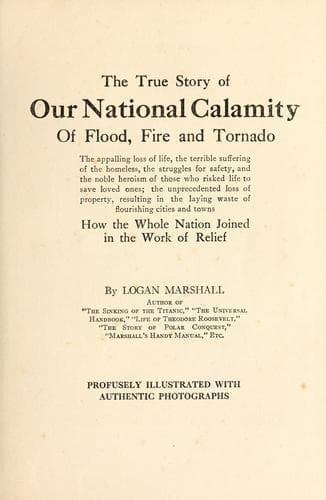
The True Story of Our National Calamity of Flood, Fire and TornadoMarshall, Logan
History
The True Story of Our National Calamity of Flood, Fire and Tornado
Marshall, Logan
Floods -- Ohio River Valley; Omaha (Neb.) -- Tornado, 1913
The rush of the currents claimed the greatest toll of lives, judging
from how most of the bodies recovered were found. They were washed up
onto the ground from new-made rivers and many were found buried in the
wreckage. In moving this workmen moved carefully, fearing they might
tread upon bodies, but they were not found in groups.
It was anticipated that the majority of the bodies of flood victims
would be found buried under the debris in the Miami Canal under great
piles of wreckage and far down the Miami River, at Miamisburg,
Middletown and Hamilton. Those who were drowned for the most part were
caught in the streets either while on their way to their places of
business and employment or while trying to get to places of safety when
forced to flee from their houses. Lieutenant Leatherman, surgeon of the
Third Regiment, O. N. G., who went through the flood in West Dayton,
said that he saw scores of dead bodies floating down the Miami River and
many people were swimming, but there was not one chance in ten thousand
that these were saved, he said.
The policing of the city by the military was reorganized with
Brigadier-General George H. Wood commanding and Captain Tyrus G. Reed as
Adjutant General. The city was turned over into a military district of
five military zones, and rigid orders were laid down for the conduct of
its affairs.
Chairmen of the various committees were unanimous in asking that word be
spread broadcast that mere sightseeing visitors were not wanted. The
railroads were informed of this attitude and conductors refused to
accept passengers who could not show that their presence here was
necessary. There were thousands of visitors in the city. Most of them
were from surrounding towns.
BOAT CREWS SAVE 979
The work of extending succor to the marooned inhabitants of the
districts which were still flooded continued during the day. In many
sections were to be seen rowboats, skiffs and canoes making their way
with extreme difficulty among the heaps of wreckage and overturned
houses among tangled meshes of telegraph, telephone and electric light
wires, seeking out possible victims who had been uncared for.
Among the organizations engaged in rescue work was the company of naval
reserves from the United States ship Essex at Toledo, under command of
Captain A. F. Nicklett. The company reached Dayton on a special relief
train from Toledo Thursday and immediately launched a number of boats on
the raging torrents which were sweeping the city from end to end. Up to
six o'clock Saturday night the sailors had been constantly on duty and
had to their credit a total of 979 lives saved, and they were not
thinking of sleep when darkness fell.
Public-domain text, read in full here on John Shaqi.
Reviews
Reviews
No reviews yet
Be the first to share your thoughts on this work.
Join the Discussion
Join the discussion
Sign in to leave a comment or review.
Sign InorCreate an account