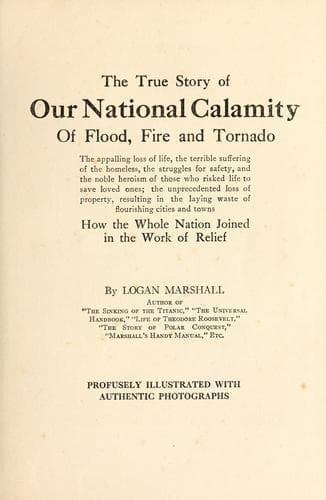
The True Story of Our National Calamity of Flood, Fire and TornadoMarshall, Logan
History
The True Story of Our National Calamity of Flood, Fire and Tornado
Marshall, Logan
Floods -- Ohio River Valley; Omaha (Neb.) -- Tornado, 1913
One crew in command of Ensign E. E. Diebald, with two boats, rescued 375
persons from the business section and that district immediately east of
Main Street and west of Eagle Street. Many of the people were taken from
their homes only after the sailors had mounted to the tops of partially
overturned houses and chopped their way through to the attics where the
inmates were huddled together waiting for death to enter.
Another crew under Junior Lieutenant Ross Willoh succeeded in saving
360, while three boats in command of Senior Lieutenant Theodore Schmidt
rescued 244 persons. The majority of these latter were taken from box
cars, warehouses, freight sheds and grain elevators in the railroad
yards. It was here that the water attained its greatest violence,
rushing in whirlpools between the irregular buildings on either side of
the tracks. Navigation was extremely perilous on account of many
submerged box cars, flat cars and overturned sheds.
Several times the sailors were capsized, but managed to keep with their
boats and right them again. Not a single life was lost either among the
reserves or among the hundreds whom they attempted to rescue.
While sailors worked incessantly to save lives, Lieutenant Walter
Gayhart, also of the ship's company, succeeded in establishing a supply
station on East Fifth Street, where many refugees congregated, and
issued rations to the suffering. He slept Saturday night after
seventy-one hours of continuous labor.
With the additional military forces which arrived the city was
thoroughly policed. At night the city was in darkness again. It was
impossible to do much relief work at night and the curfew order was due
in part to the advisability of keeping the men where they could protect
their own households if necessary.
RELIEF ON BUSINESS BASIS
The distribution of food supplies and clothing and relieving of distress
was put on a business basis. Supplies reached Dayton in large
quantities, and the relief stations were sufficiently organized to take
care of the incoming refugees from the flood districts. The problem of
caring for the homeless was still serious, but with all promise of warm
weather it was hoped there would be less suffering. Health officers
reported that there was only one car of lime in the city, and there was
great need of more.
Fifteen thousand persons were subsisting on rations given out under
direction of the relief committee. Ten thousand of these, it was
estimated, were in their homes, and food was carried to them in boats
and automobiles. About five thousand were being cared for at the relief
stations. This showed a marked reduction in the number of persons being
publicly fed.
There was plenty of food, and it was placed into baskets in lots to
serve five persons for two days. Over candles given out with the food
the people boiled coffee, but the other food was eaten cold. There was
no gas and little coal.
Public-domain text, read in full here on John Shaqi.
Reviews
Reviews
No reviews yet
Be the first to share your thoughts on this work.
Join the Discussion
Join the discussion
Sign in to leave a comment or review.
Sign InorCreate an account