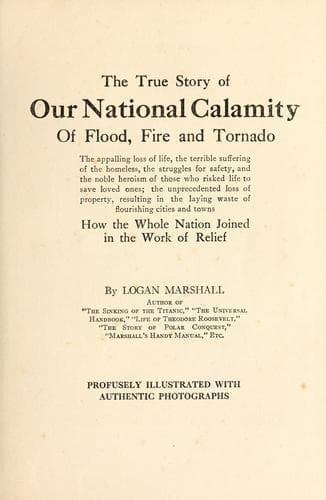
The True Story of Our National Calamity of Flood, Fire and TornadoMarshall, Logan
History
The True Story of Our National Calamity of Flood, Fire and Tornado
Marshall, Logan
Floods -- Ohio River Valley; Omaha (Neb.) -- Tornado, 1913
In Riverdale and North Dayton, where the flood waters attained the
greatest depth and degree of destructiveness, several thousand persons
waded knee-deep in slimy mud, rummaging their desolated homes for
clothing. All of this, of course, was soaked and plastered with mud, but
it was dried on the hillsides, where the populace had taken refuge. In
some places in these districts the water had so far receded as to render
possible the beginning of the work of cleaning the lower floors of the
mud and debris.
The dead line around Riverdale, where the water remained about three
feet in depth around most of the houses, continued to be maintained in
order to guard against looting during the absence of residents. It was
estimated that not more than a week would be required to immunize all
homes requiring it outside of the Riverdale section, to free them from
water and prepare them for cleansing.
A SUMMARY OF WORK ACCOMPLISHED
Following are some of the things accomplished since the flood broke over
the city Tuesday morning:
The water-works pumping station was in operation, but the distribution
of water was greatly retarded by open pipes in wrecked houses. The
pressure was feeble, but growing stronger as leaks were checked.
The main sanitary sewer was in operation, although many of the laterals
leading from houses were clogged with mud and backed-up water.
The flood sewers, separate from the sanitary, were almost ready for
service. These sewers carry off the rainfall from the gutters, and were
needed to remove the water being pumped from basements.
Sightseers in motor cars felt the heavy hand of public necessity when
General Wood began impressing machines. The sightseers were ordered from
their cars and the latter were pressed into public service. Protests
were unavailing. The more stubborn surrendered at the points of rifles,
and gave up their cars "until released by order of the chairman," as the
placards placed in them read.
The militia also began impressing citizens into service as workers. Men
who had the appearance of being able-bodied, but idle, were questioned
by officers of the National Guard; if they had not good reason for being
in the streets, and no duties of a mandatory nature, they were pressed
into service.
The Sixth regiment, O. N. G., from Toledo and northern Ohio towns, which
had been on duty in Dayton, commandeered a train when ordered to
Cincinnati and departed before nightfall. The naval reserves from Toledo
went on train.
Coroner J. W. McKemy estimated that one hundred bodies had been
recovered, though there was record of only seventy-two. He said some had
been buried without usual official action and that in some cases he did
not expect to get records.
Public-domain text, read in full here on John Shaqi.
Reviews
Reviews
No reviews yet
Be the first to share your thoughts on this work.
Join the Discussion
Join the discussion
Sign in to leave a comment or review.
Sign InorCreate an account