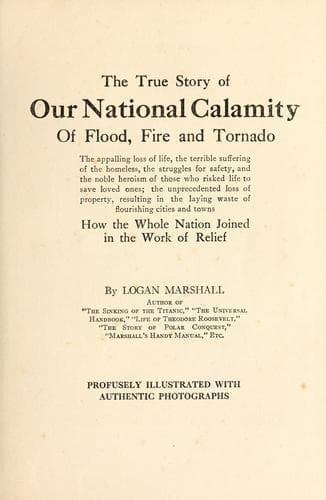
The True Story of Our National Calamity of Flood, Fire and TornadoMarshall, Logan
History
The True Story of Our National Calamity of Flood, Fire and Tornado
Marshall, Logan
Floods -- Ohio River Valley; Omaha (Neb.) -- Tornado, 1913
The troubles of Cincinnati began on Tuesday, March 25th, when the city
experienced a cloudburst that started the gauge rising in the Ohio
River, temporarily flooded the streets of the city and carried away two
bridges over the White Water River, at Valley Junction a short distance
to the south.
PREPARING FOR THE WORST
By Thursday Cincinnati was facing one of the worst floods in her
history. It had rained steadily for twenty-four hours. The flood had
entered several business houses in the lower section during the night
and early morning found the entire "bottoms" a sea of moving vans,
working up to their capacity. At eight o'clock in the evening the gauge
showed 60, a rise of more than three feet since the same hour that
morning.
East and west of the city on the Ohio side of the river the lowlands
were inundated and much damage done. In the low sections of the city
many houses were flooded and the inhabitants of these sections fled to
higher ground.
Across the river at Newport and Covington, Kentucky suburbs of
Cincinnati, similar conditions prevailed and the police early warned
dwellers of the danger that threatened. Dayton and Ludlow, other
Kentucky suburbs, were also sufferers from the rising flood and many
houses were already completely under water.
[Illustration: TOPOGRAPHY OF STRICKEN SECTION OF TWO STATES
Practically every town and city shown in this illustration suffered from
the floods, most of them from loss of life and all of them from property
damage.]
A seventy-foot stage for Cincinnati was predicted. The Central Union
Station was abandoned and all trains leaving or entering the city were
detoured.
ANXIOUS WAITING
Slowly the treacherous waters rose while tired watchers waited
anxiously. Conditions were not acute but distressing. The people knew
that they must face conditions worse than the present. All the lowland
to the west and east of the city had been submerged and also along the
water front of the business section the commercial houses were gradually
disappearing under the yellow river. Hundreds of families along the
river front in Cincinnati had been forced to move by the encroaching
river and many merchants had removed their goods from cellars and
basements to higher ground.
Chief of Police Copeland, however, had the flood work well in hand. The
police were put on twelve-hour duty and worked in the flooded territory
in rowboats.
The city armory sheltered many persons and preparations were made to
distribute food at the city jail. Nearly every landing place along the
river front was piled high with furniture, bedding and other household
effects.
HOMES SUBMERGED
Along the Kentucky shore conditions rapidly became worse. At Covington
more than five hundred houses were submerged and their occupants given
shelter and protection in public buildings.
Public-domain text, read in full here on John Shaqi.
Reviews
Reviews
No reviews yet
Be the first to share your thoughts on this work.
Elsewhere in the archive
Join the Discussion
Join the discussion
Sign in to leave a comment or review.
Sign InorCreate an account