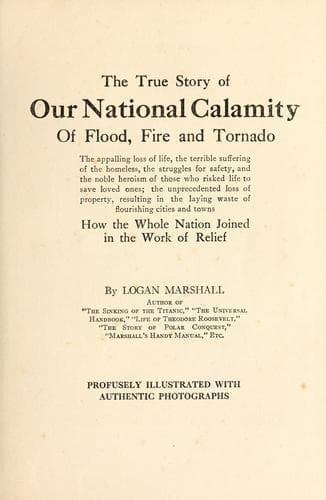
The True Story of Our National Calamity of Flood, Fire and TornadoMarshall, Logan
History
The True Story of Our National Calamity of Flood, Fire and Tornado
Marshall, Logan
Floods -- Ohio River Valley; Omaha (Neb.) -- Tornado, 1913
Reports on the following day were still more alarming. The worst
conditions prevailed in Kokomo, Wabash, Peru, Logansport, Lafayette and
Terra Haute. Thousands of people all along the Wabash were crying for
food and shelter. Wabash, Kokomo, Peru, Logansport and Lafayette were
entirely cut off from communication with the outside world. A big
snowstorm on the heels of a drop in temperature added to the suffering.
Rescue work was carried on by volunteers, police, firemen and the state
militia, and every place where there was a dry home was thrown open to
the flood refugees.
From many places frantic appeals for aid were received by the state
officials, but lack of all means of transportation and crippled
telephone and telegraph service forced the submerged towns to rely
entirely upon their own resources.
THE PLIGHT OF KOKOMO
At Kokomo the water in some of the streets was eight feet deep and
rushing like a mountain torrent. Schools and business were suspended and
state troops patrolled the town as far as they were able. The homes of a
thousand persons were submerged. No lives were lost, but there were many
narrow escapes. Several persons were rescued from second story windows
by the few boats available. Rafts could not be used because of the
swiftness of the current.
THE HOMELESS IN WABASH
Seven hundred and fifty persons in Wabash were rendered homeless as the
result of the high flood in the river. The city was without gas, water
or lighting facilities.
The mayor on Thursday, March 27th, issued a proclamation ordering that
all saloons and business houses close at six o'clock. He instructed the
police to keep people off the streets.
There was no loss of life, but the property loss was estimated at
$350,000.
There was no communication with the outside world from Monday until
Thursday afternoon.
DISTRESS OF LOGANSPORT
The business district and the south and west sides of Logansport were
under water on Tuesday. The bridge at the country club had been washed
away. Other bridges over the Wabash had been flooded. The moving vans
were unable to handle all the persons trying to move out of the danger
zone and the firemen of the city gave aid. The electric light and water
plants were endangered. There was great suffering among the poorer
people. Logansport was also cut off from telephone and telegraph
communication. Two deaths by drowning were reported (later corrected to
one) and ten houses were washed down stream.
MILITARY CADETS AID IN RELIEF
On Wednesday the flood waters of the Wabash were sixteen feet deep on
the floors of the Pennsylvania Railroad Station, and cadets from the
Culver Military Academy were rushed to the city to aid in the rescue and
relief of scores of people marooned in the business districts.
The Third Street bridge had been swept away. The bridge at Sixth Street
was being washed out. The people were fleeing to the hills, where they
were housed in school houses and churches.
Public-domain text, read in full here on John Shaqi.
Reviews
Reviews
No reviews yet
Be the first to share your thoughts on this work.
Elsewhere in the archive
Join the Discussion
Join the discussion
Sign in to leave a comment or review.
Sign InorCreate an account