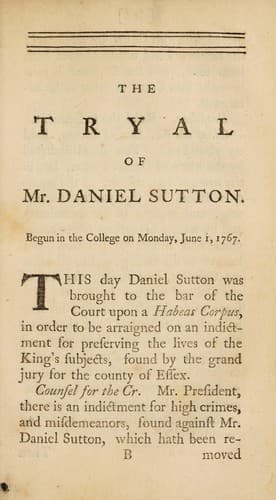
The tryal of Mr. Daniel Sutton, for the high crime of preserving the lives of His Majesty's liege subjects, by means of inoculationSutton, Daniel
History
The tryal of Mr. Daniel Sutton, for the high crime of preserving the lives of His Majesty's liege subjects, by means of inoculation
Sutton, Daniel
Smallpox -- Vaccination -- Great Britain -- Early works to 1800; Sutton, Daniel, 1735-1819
As to that article of the indictment, which relates to the means of
perpetrating the crime of which the Prisoner is accused, namely, by
secret medicines and modes of practice unknown to this College, and to
all other practitioners, we have proved very clearly, by Dr. Ruston’s
experiments, that the composition of the medicines is certainly
known. But that they consist chiefly of a mercurial preparation, is
sufficiently evident from their effects. Now that mercury hath been
very commonly used as a preparative to inoculation, we have proved to
you by the testimony of several witnesses of indisputable character.
And with regard to the vegetable diet, enjoined by the Prisoner at
the bar, it is so far from being peculiar to him, that it hath very
long been the common practice. As to his manner of communicating the
infection by means of the lymph taken before the eruptive fever,
whether it be the invention of the Prisoner, or not, is a matter of no
importance, as it is now a very common, and therefore not a secret mode
of practice.
I come now to that part of his practice, in which he hath been thought
most singular, and which hath generally been imagined to be his own
invention: I mean his cool regimen; that is, the practice of exposing
his patients to the open air, and giving them cold water to drink. But,
though this practice may not have been carried to the present extreme
by regular physicians, it is nevertheless most certain, that they could
not be ignorant how strenuously it was recommended, in the natural
small-pox, by many writers of the first distinction.
Rhases, an Arabian physician, who wrote some hundred years ago, in
his chapter _De præservatione, et de modo impediendi_, &c. expresses
himself, concerning the use of cold water, in order to extinguish
the variolous fever, in these words: _Bibendam præbe aquam in nive
refrigeratam in summo frigiditatis gradu, effusim et affatim datam, et
brevibus intervallis; ita ut ea prematur, et frigiditatem ejus sentiat
in intestinis suis ægrotus. Quod si posthac febricitet, et in illum
redierit ardor; potui illam dato secunda vice, videlicet a libris
duabus ad tres, et amplius, in semihoræ spatio. Quod si adhuc calor
redierit, et venter aqua repletus fuerit; fac ut illam evomat: tum
denuo aquam bibendam præbe._ Thus, gentlemen of the jury, you hear,
that this early, this celebrated writer on the small-pox, carried the
use of cold water far beyond the practice of our most adventurous
inoculators. He not only ordered his patients to drink cold water
till they were full, but made them spew it up, and drink again. Now,
though our learned and regular physicians, who had some tenderness
for their patients, and some reputation to lose, did not dare to try
what appeared to them a dangerous experiment, it is, nevertheless, a
practice of which they could not be ignorant; and of which the Prisoner
is undoubtedly guiltless of being the inventor.
Public-domain text, read in full here on John Shaqi.
Reviews
Reviews
No reviews yet
Be the first to share your thoughts on this work.
Join the Discussion
Join the discussion
Sign in to leave a comment or review.
Sign InorCreate an account