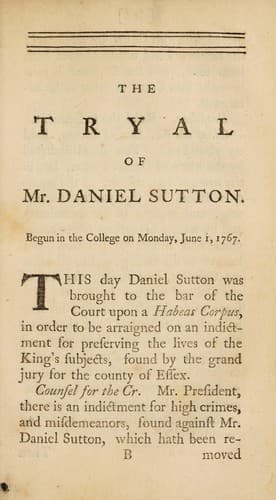
The tryal of Mr. Daniel Sutton, for the high crime of preserving the lives of His Majesty's liege subjects, by means of inoculation — John Shaqi
The tryal of Mr. Daniel Sutton, for the high crime of preserving the lives of His Majesty's liege subjects, by means of inoculationSutton, Daniel
History
The tryal of Mr. Daniel Sutton, for the high crime of preserving the lives of His Majesty's liege subjects, by means of inoculation
Sutton, Daniel
Smallpox -- Vaccination -- Great Britain -- Early works to 1800; Sutton, Daniel, 1735-1819
_Couns. for the Cr._ Now, Sir, please to inform the Court what you
have learnt concerning the progress of the disease and the manner of
treating it.
_Dr. Baker._ Three days after the operation, if it succeed, there
appears on the incision a spot, like a flea bite, not as yet above the
skin, which gradually becomes first a red pimple, and then a bladder
full of clear lymph, advancing to maturation with the pustules. In
proportion as the discolouration round the place of incision is
greater, the less quantity of eruption is expected; therefore, when
this circle is small, stronger and more frequent cathartics are
exhibited. If, when the fever comes on, there appears no tendency
to perspiration, some acid drops, or more powerful sudorifics, are
administered. In general, during the burning heat of the fever, he
gives cold water; but after the perspiration begins, warm baum-tea, or
water-gruel. As soon as the sweat abates, the eruption having appeared,
he obliges every body to get up, to walk about the house, or into the
garden. From this time, to the turn of the disease, he gives milk-gruel
_ad libitum_. On the following day he gives a dose of Glauber’s salts,
and, if the eruption be considerable, he repeats it on the third day.
_Couns. for the Cr._ Pray, Sir, can you give the Court any information
relative to the number of persons that have been inoculated by the
Prisoner and his assistants?
_Dr. Baker._ According to the best information that I can procure,
about seventeen thousand have been thus inoculated, of which number no
more than five or six have died.
Mr. B. CHANDLER sworn.
_Couns. for the Cr._ You, Sir, I think are a surgeon at Canterbury?
_Mr. Chandler._ I am.
_Couns. for the Cr._ Pray, Mr. Chandler, can you give us any
information concerning the Prisoner’s success in the practice of
inoculation?
_Mr. Chandler._ I know nothing of Mr. Sutton’s own particular practice,
except from report. What I have to say relates only to that of one of
his assistants, or partners.
_President._ This evidence cannot affect the Prisoner at the bar, as he
tells you he knows nothing of Mr. Sutton’s own particular practice.
_Couns. for the Cr._ I beg your pardon, Mr. President, the Prisoner
at the bar stands indicted for preserving the lives of the King’s
subjects, not only by inoculating, but also causing to be inoculated.
_President._ Proceed to his examination.
_Couns. for the Cr._ Pray, Mr. Chandler, who is this assistant or
partner, with whose practice you are acquainted?
_Mr. Chandler._ He is a surgeon of eminence at Maidstone; his name is
Peale.
_Couns. for the Cr._ Where was it that you saw his practice?
_Mr. Chandler._ In the city of Canterbury.
_Couns. for the Cr._ What number of persons might he inoculate in that
city?
_Mr. Chandler._ I cannot exactly tell; but it is considerable.
_Couns. for the Cr._ Did any of his patients die under inoculation?
_Mr. Chandler._ Not that I know of.
Public-domain text, read in full here on John Shaqi.
Reviews
Reviews
No reviews yet
Be the first to share your thoughts on this work.
Join the Discussion
Join the discussion
Sign in to leave a comment or review.
Sign InorCreate an account