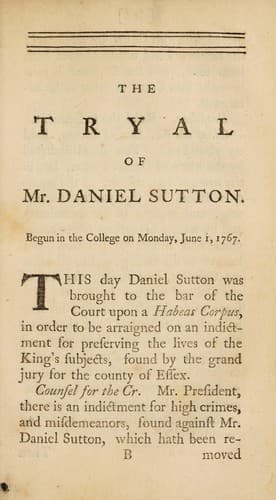
The tryal of Mr. Daniel Sutton, for the high crime of preserving the lives of His Majesty's liege subjects, by means of inoculationSutton, Daniel
History
The tryal of Mr. Daniel Sutton, for the high crime of preserving the lives of His Majesty's liege subjects, by means of inoculation
Sutton, Daniel
Smallpox -- Vaccination -- Great Britain -- Early works to 1800; Sutton, Daniel, 1735-1819
_Dr. Ruston._ Yes. I poured on one of them a few drops of volatile
alkali, and it immediately struck a deep black. The same appearance
was produced by salt of tartar, and by lime-water. I then added a few
grains of calomel to the _pilulæ cochiæ_, and repeated the experiments
with the same effect.
_Couns. for the Prisoner._ And what discoveries have you made
concerning the drops?
_Dr. Ruston._ The acid drops with which he prepares his punch, is so
obviously of the same nature with the dulcified volatile vitriolic
acid that arises during the distillation of æther, and which is the
same with what exists in large quantities in the _liquor anodinus_
of Hoffman, that it was unnecessary to submit it to any chemical
experiment. There was nothing foreign in its composition.
_Couns. for the Cr._ Not to interrupt the course of your examination,
I beg leave, before you proceed, to ask the Doctor one question. If I
remember right, you said, the powder contained ten grains of calomel.
Pray, Doctor, is not this an unusual large dose?
_Dr. Ruston._ As an alterative it certainly is so; and therefore Mr.
Sutton’s powders have often been known to salivate the patient. But its
activity is somewhat weakened by the sulphur contained in the æthiops.
_Couns. for the Cr._ But has it not been generally supposed that there
was some other powerful ingredient in Mr. Sutton’s medicines?
_Dr. Ruston._ Yes, antimony. But from my experiments, I am convinced of
the contrary.
_Couns. for the Pris._ Now, Doctor, give me leave to ask you, whether
the exhibition of mercury, as preparative to inoculation, be the
invention of the Prisoner at the bar?
_Dr. Ruston._ Certainly not.
_Couns. for the Pris._ Who were the inventors of this practice?
_Dr. Ruston._ I cannot answer positively to that question. The great
Boerhaave, in his Aphorisms, recommended the experiment of uniting
mercury with antimony as an antidote to the variolous virus; but I
believe some American physicians were the first who used mercury in
preparing for inoculation.
_Couns. for the Pris._ And with what success?
_Dr. Ruston._ With very great. Out of the first three thousand
inoculated, only five died; and these were all children, who could not
be prevailed on to take the medicine.
_Couns. for the Pris._ I beg, gentlemen of the jury, you will remember
this circumstance--All that took the mercurial medicines recovered.
Pray, Dr. Ruston, was this new method of preparation long confined to
any particular physician, or part of America?
_Dr. Ruston._ No: the fame of its extraordinary success soon produced
a number of inoculators on the new plan; so that in a short time it
spread from one end of the continent to the other.
_Couns. for the Pris._ Did these several inoculators all give precisely
the same medicines?
_Dr. Ruston._ Not precisely.
_Couns. for the Pris._ In what respect do they differ?
_Dr. Ruston._ Principally in the proportions of calomel and antimony.
Public-domain text, read in full here on John Shaqi.
Reviews
Reviews
No reviews yet
Be the first to share your thoughts on this work.
Join the Discussion
Join the discussion
Sign in to leave a comment or review.
Sign InorCreate an account