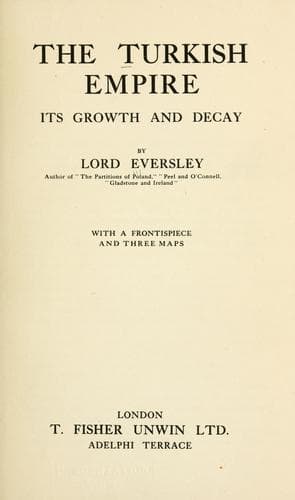
The Turkish Empire, Its Growth and DecayEversley, G. Shaw-Lefevre (George Shaw-Lefevre), Baron
History
The Turkish Empire, Its Growth and Decay
Eversley, G. Shaw-Lefevre (George Shaw-Lefevre), Baron
Turkey -- History
4. The evil practice introduced by Solyman of heaping favours on his
favourite viziers, or of allowing them to amass wealth by selling their
favours to those below them in the official hierarchy. Ibrahim, who was
Grand Vizier for thirteen years, and Roostem for fifteen years, amassed
enormous fortunes. They set up a standard of extravagant life, which
was followed by other viziers and high officials. Roostem on his death
was possessed of 815 farms in Anatolia and Roumelia, 476 watermills,
1,700 slaves, 2,900 coats of mail, 8,000 turbans, 760 sabres, 600
copies of the Koran, 5,000 books, and two millions of ducats. His
example in gaining wealth was followed by others in a minor degree
according to their opportunities. High office came to be regarded as a
means and opportunity of acquiring great wealth, and this evil rapidly
spread throughout the Empire and led to corruption and extortion.
There was a corrective, or perhaps it should be called a nemesis to
this, in the fact that when an official was put to death, by order
of the Sultan, his property was confiscated to the State. Ibrahim’s
immense wealth was thus dealt with, and even in Solyman’s time, and
much more so in those of his successors, the confiscated fortunes of
viziers, governors, and other officials sentenced to death formed an
important item in the annual income of the State. There can be little
doubt that not a few pashas were put to death by the successors of
Solyman in order that the State might benefit from the confiscation
of their fortunes. It was perhaps thought that the mere fact of
accumulation of wealth by an official was sufficient proof that it had
been improperly acquired, and that the holder deserved to lose his life
and fortune.
Public-domain text, read in full here on John Shaqi.
Reviews
Reviews
No reviews yet
Be the first to share your thoughts on this work.
Elsewhere in the archive
Join the Discussion
Join the discussion
Sign in to leave a comment or review.
Sign InorCreate an account