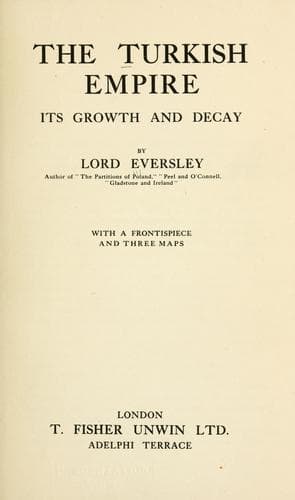
The Turkish Empire, Its Growth and DecayEversley, G. Shaw-Lefevre (George Shaw-Lefevre), Baron
History
The Turkish Empire, Its Growth and Decay
Eversley, G. Shaw-Lefevre (George Shaw-Lefevre), Baron
Turkey -- History
The Russian army on land was more fortunate. Their chief operation
in 1790 was the capture of Ismail, a most important fortress on the
northern affluent of the Danube, about forty miles from the Black Sea.
So long as this city was in the hands of the Turks an advance of an
invading army from Bessarabia into Bulgaria was hardly possible. The
fortress was defended by a very large garrison. Suvorov was again put
at the head of a _corps d’armée_ by Potemkin, the commander-in-chief,
with the laconic order, “You will capture Ismail, whatever may be
the cost.” Six days after his arrival before the fortress, Suvorov
ordered his troops to assault it. Speaking to them in his usual jocular
manner, he said: “My brothers, no quarter; provisions are scarce.” At
a terrible cost of life the city was taken by storm. A scene of savage
carnage ensued, unprecedented even in the experience of Suvorov.
Thirty-four thousand Turks perished. Suvorov admitted to a friend that
he was moved to tears when the scene was over. But he was accustomed
to shed these crocodile tears after horrors of this kind, when he had
made no effort to mitigate them. When news of the achievement arrived
at St. Petersburg, the Empress, at her levée, addressing the British
Ambassador, Sir C. Whitworth, said, with an ironic smile: “I hope that
those who wish to drive me out of St. Petersburg will allow me to
retire to Constantinople.”
Meanwhile the allied maritime Powers—England, Prussia, and
Holland—having succeeded in their mediation between Austria and Turkey,
and in restoring peace between them, on the basis of the _status quo_,
were now engaged in efforts of the same kind as between Russia and
Turkey. They offered mediation to the Empress Catherine in the course
of 1790. In a reply to the Prussian King, she indignantly rejected
intervention. “The Empress,” she said, “makes war and makes peace when
she pleases. She will not permit any interference whatever in the
management or government of her affairs.” It was understood, however,
that she was not disinclined to peace upon the terms that Oczakoff
and the district between the Rivers Dniester and Bug, which were in
her full possession, were to be retained by her, and that all other
of her conquests were to be restored to Turkey. The allied Powers
were unwilling to assent to this, and made preparations for an armed
mediation to compel Russia to restore Oczakoff to Turkey.
Public-domain text, read in full here on John Shaqi.
Reviews
Reviews
No reviews yet
Be the first to share your thoughts on this work.
Elsewhere in the archive
Join the Discussion
Join the discussion
Sign in to leave a comment or review.
Sign InorCreate an account