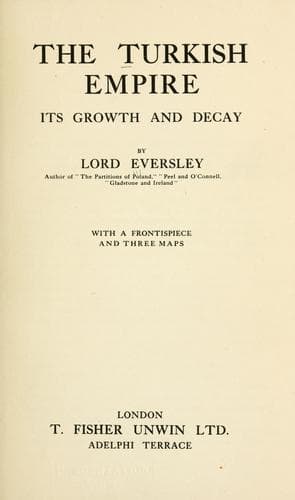
The Turkish Empire, Its Growth and DecayEversley, G. Shaw-Lefevre (George Shaw-Lefevre), Baron
History
The Turkish Empire, Its Growth and Decay
Eversley, G. Shaw-Lefevre (George Shaw-Lefevre), Baron
Turkey -- History
In the case of Great Britain, the proposed intervention on behalf of
the Turks in support of their Empire was a new departure in policy.
Its Government had been closely allied with that of Russia during
the greater part of the eighteenth century. Its policy had been
mainly determined by jealousy of France. It looked upon Russia as
a counterpoise to that State. It had never raised any objection to
the ambitious projects of Russia against Turkey. Lord Chatham, whose
foreign policy had prevailed till now, had always held that it was not
the interest of England to enter into a connection with the Turks.
England had looked on with indifference in 1784, when the Empress
Catherine had taken possession of the Crimea. Charles Fox was at that
time Minister of Foreign Affairs in England, and he showed himself as
much in favour of Russia as Chatham had been. “My system of foreign
politics,” he wrote, “is deeply rooted. Alliance with the northern
Powers (including Russia) ever has been and ever will be the system of
every enlightened Englishman.” It was an entirely new departure when
the younger Pitt, in 1790, entered the lists in alliance with Prussia
against Russia in order to restore and maintain the balance of power in
the south-east of Europe in favour of Turkey.
The British Government renewed its offer of mediation. Its Ambassador
at St. Petersburg was instructed to inform the Empress that if she
would accept a peace on the basis of the _status quo_, England would
use her influence to obtain from the Turks a formal renunciation of
their claims to the Crimea under the guarantee of the allies. The
Empress, in her reply through her minister, expressed her indignation
at the unparalleled conduct of the allies in attempting to dictate in
so arbitrary a manner to a sovereign perfectly independent, and in want
of no assistance to procure the conditions which seemed to her best
suited to satisfy her honour. Rather than diminish the glory of a long
and illustrious reign, the Empress was ready to encounter any risk, and
she would only accept the good offices of the King of England “inasmuch
as they may lead to preserve for her the indemnification she requires
of Oczakoff and its district.”[30]
The reply was important, for it showed that Russia was, at all
events, willing to bring the war to an end and to forgo its intention
of driving the Turks out of Europe. The fact was that, in spite of
repeated victories, the Russian losses in killed and wounded, and still
more by disease, were very serious. The Empress also had other troubles
on her hands. The Polish question, in which she was more interested
than in that of Turkey, was imminent. The Second Partition was decided
on. It was necessary for her to have a free hand. In spite of this, she
was determined not to yield possession of Oczakoff.
Public-domain text, read in full here on John Shaqi.
Reviews
Reviews
No reviews yet
Be the first to share your thoughts on this work.
Elsewhere in the archive
Join the Discussion
Join the discussion
Sign in to leave a comment or review.
Sign InorCreate an account