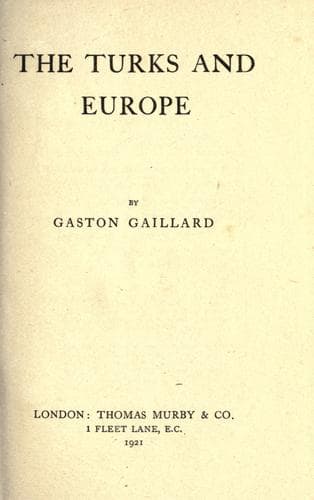
Treaty of Sèvres (1920); World War, 1914-1918 -- Territorial questions -- Turkey; World War, 1914-1918 -- Turkey
“Any possibility of mere defence against an attack would thus be
taken away from Turkey, whose capital would henceforth be within
the range of her enemies’ guns.
“The sovereignty of the State would also be deeply infringed upon
in all matters relating to legislation, international treaties,
finance, administration, jurisdiction, trade, etc., so that finally
the crippled Ottoman Empire would be stripped of every attribute of
sovereignty both at home and abroad, but would be held responsible
all the same for the execution of the Peace Treaty and the
international obligations pertaining to every State.
“Such a situation, which would be an utter denial of justice, would
constitute both a logical impossibility and a judicial anomaly.
For, on the one hand, it is impossible to maintain a State and
at the same time divest it of all that is an essential judicial
condition of its existence; and, on the other hand, there cannot be
any responsibility where there is no liberty.
“Either the Allied Powers are of opinion that Turkey should
continue to exist, in which case they should make it possible for
her to live and fulfil her engagements by paying due regard to her
rights as a free, responsible State.
“Or the Allied Powers want Turkey to die. They should then execute
their own sentence themselves, without asking the culprit—to whom
they did not even give a hearing—to append his signature to it and
bring them his co-operation.”
After these general considerations and some remarks as to the
responsibility of Turkey, the fundamental rights of the State, and
the right of free disposal of peoples, the Ottoman Government made
counter-proposals which were quite legitimate, and at the same time
bore witness to its goodwill.
This document, to which we refer the reader for further particulars,
may be summed up as follows: The Turkish Government recognises the new
States of Poland, Serbia-Croatia-Slovenia, and Czecho-Slovakia. It
confirms the recognition made by Turkey in 1918 of Armenia as a free,
independent State. It also recognises the Hejaz as a free, independent
State. It recognises the French protectorate over Tunis. It accepts all
economic, commercial, and other consequences of the French protectorate
over Morocco, which was not a Turkish province. It renounces all rights
and privileges over Libya and the isles and islets of the Ægean Sea.
It recognises Syria, Mesopotamia, Palestine, as independent States. It
recognises the British protectorate over Egypt, the free passage of
the Suez Canal, the Anglo-Egyptian administration of the Soudan, the
annexation of Cyprus by Great Britain.
In regard to Constantinople and the régime of the zone of the Straits,
the Ottoman delegation remarked that according to the terms of the
treaty there would be together in that town—
“First, His Imperial Majesty the Sultan and the Turkish Government,
whose rights and titles shall be maintained.
Public-domain text, read in full here on John Shaqi.
Reviews
Reviews
No reviews yet
Be the first to share your thoughts on this work.
Elsewhere in the archive
Join the Discussion
Join the discussion
Sign in to leave a comment or review.
Sign InorCreate an account