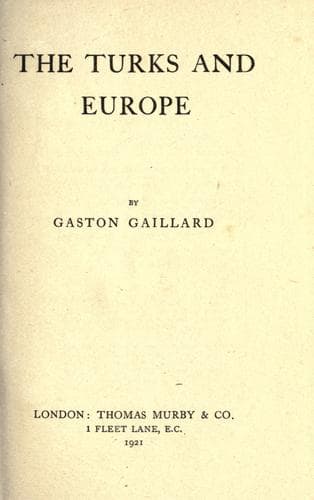
Treaty of Sèvres (1920); World War, 1914-1918 -- Territorial questions -- Turkey; World War, 1914-1918 -- Turkey
In 1888 Khorene Achikian, who succeeded Vehabedian, was also accused of
being on friendly terms with the Turks, and the committees strove to
have him replaced by Narbey, who had been a member of the delegation
sent to Europe for the Berlin Congress.
This Armenian movement naturally caused some incidents between the
various elements of the population, which were magnified, brought by
the bishops and consuls to the knowledge of the European Powers, and
cited as the outcome of Turkish cruelty.
After the Turco-Russian war, the revolutionary agitation which stirred
up Russia and the Caucasus had its repercussion among the Armenians,
and the harsh measures of the Tsar’s Government only strengthened the
agitation by increasing Armenian discontent.
Miguirditch Portokalian, a teacher living at Van, came to Marseilles,
where in 1885 he edited a newspaper, _Armenia_. At the same time Minas
Tscheraz started another newspaper in Paris under the same title. These
publicists, both in their journals and in meetings, demanded that
Article 61 of the Berlin treaty should be carried out.
In 1880 some revolutionary committees were formed in Turkey. In 1882
“The Association of the Armed Men” was founded at Erzerum; some of its
members were arrested, and the association itself was dissolved in 1883.
A rising took place at Van in 1885 on the occasion of the election of a
bishop, and some insurrectionist movements occurred at Constantinople,
Mush, and Alashehr under various pretexts.
Next year, in 1886, one Nazarbey, a Caucasian by birth, and his
wife Maro, formed in Switzerland the _Huntchag_ (the Bell), a
social-democrat committee that aimed at getting an autonomous
administration for the Armenians, and published in London a monthly
periodical bearing the same name. This committee meant to achieve its
object not through the intervention or mediation of the European
Powers—to which it thought it useless to make another appeal, as their
individual interests were so much at variance—but solely by the action
of its organisations throughout the country, which were to raise funds,
equipment, foment troubles, weaken the Government, and take advantage
of any opportunity that might occur.
The _Huntchag_ committee found representatives in every great
town—Smyrna, Aleppo, Constantinople, etc.—and its organisation was
completed in 1889.
In 1890, at the instigation of the Huntchagists, a rebellion broke out
at Erzerum, and incidents occurred in various places. At Constantinople
a demonstration of armed men, headed by the Patriarch Achikian,
repaired to the Sublime Porte to set forth their grievances, but
were scattered; and the Patriarch, who was reproached with being too
moderate, and whose life was even attempted, had to resign.
In fact the _Huntchag_ committee, which enlisted the effective and
moral support of the representatives of the Powers, especially those of
Russia and England, carried on its intrigues without intermission, and
increased its activity.
Public-domain text, read in full here on John Shaqi.
Reviews
Reviews
No reviews yet
Be the first to share your thoughts on this work.
Elsewhere in the archive
Join the Discussion
Join the discussion
Sign in to leave a comment or review.
Sign InorCreate an account