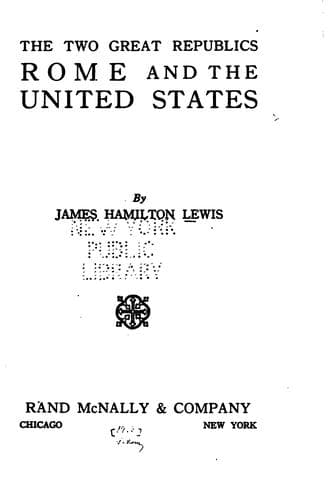
The Two Great Republics: Rome and the United StatesLewis, James
History
The Two Great Republics: Rome and the United States
Lewis, James
Rome -- Politics and government -- 510-30 B.C.; United States -- Politics and government
"The cause of this calamity was the same with that of all
others, excessive good fortune. For in the consulship of
Quintus Metellus and Lucius Afranius, when the majesty of
Rome predominated throughout the world and Rome herself was
celebrating, in the theatres of Pompey, her recent victories
and triumphs over Pontus and Armenia, the overgrown power of
Pompey, as is usual in similar cases, excited among the idle
citizens a feeling of envy towards him. Metellus,
discontented at the diminution of his triumph over Crete,
Cato, ever an enemy to those in power, calumniated Pompey,
and raised a clamour against his acts. Resentment at such
conduct drove Pompey to harsh measures, and impelled him to
provide some support for his authority. Crassus happened at
that time to be distinguished for family, wealth, and
honour, but was desirous to have his power still greater.
Caius Cæsar had become eminent by his eloquence and spirit,
and by his promotion to the consulate. Yet Pompey rose above
them both. Cæsar, therefore, being eager to acquire
distinction, Crassus to increase what he had got, and Pompey
to add to his, and all being equally covetous of power, they
readily formed a compact to seize the government. Striving,
accordingly, with their common forces each for his own
advancement, Cæsar took the provinces of Gaul, Crassus that
of Asia, and Pompey that of Spain; they had three vast
armies and thus the empire of the world was now held by
these leading personages. Their government extended through
ten years, at the expiration of this period (for they had
previously been kept in restraint by dread of one another) a
rivalry broke forth between Cæsar and Pompey, consequent on
the death of Crassus among the Parthians, and that of Julia,
who, being married to Pompey, maintained a good
understanding between the son-in-law and father-in-law by
means of this matrimonial bond. But now the power of Cæsar
was an object of jealousy to Pompey and the eminence of
Pompey was offensive to Cæsar. The one could not bear an
equal, nor the other a superior. Sad to relate, they
struggled for mastery, as if the resources of so great an
empire would not suffice for two."
The open rupture between Cæsar on the one side and Pompey and the
Senate on the other came in the year 49 B.C. Cæsar had been promised
the consulship for the year 48 B.C., but fear of the powerful position
in which Cæsar would be placed if put in possession of the highest
civil office of the state, while still holding his influence over his
veteran army, together with distrust of Cæsar's motives and ambitions,
caused great opposition to this plan to develop at Rome.
Public-domain text, read in full here on John Shaqi.
Reviews
Reviews
No reviews yet
Be the first to share your thoughts on this work.
Elsewhere in the archive
Join the Discussion
Join the discussion
Sign in to leave a comment or review.
Sign InorCreate an account