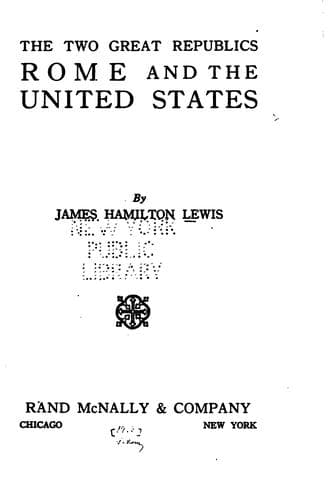
The Two Great Republics: Rome and the United StatesLewis, James
History
The Two Great Republics: Rome and the United States
Lewis, James
Rome -- Politics and government -- 510-30 B.C.; United States -- Politics and government
Cæsar, however, had his active partisans at Rome, among the most
energetic being the tribunes Gaius Curio, Mark Antony, and Gaius
Cassius. The former of these, a man of dissolute character and great
abilities as a politician, proposed to the Senate a resolution calling
upon both Cæsar and Pompey to resign their provinces.
Upon the passage of this resolution by the Senate, by a vote of three
hundred to seventy, Pompey began to raise troops without the proper
legal authority, and Cæsar refused to surrender his province, or to
appear before the Senate without the protection of his army. Cæsar,
however, sent to the Senate an offer to resign the governorship of
Transalpine Gaul and to reduce the size of his army from ten legions
to two, if the Senate would agree that he should retain the government
of Cisalpine Gaul and the two remaining legions until after the
consular election of 48 B.C. This offer was rejected by the Senate,
who then adopted a motion ordering Cæsar to disband his army and
resign his province within a fixed time under penalty of being
declared guilty of high treason. This measure was vetoed by the
tribunes, who, however, abandoned their posts and fled to Cæsar's camp
upon Pompey bringing two legions of his soldiers into Rome.
Cæsar, relying upon the support of his veteran army and of the
Transalpian Gauls, to whom, on his own authority and without any color
of legal right, he had granted the full civic rights of Roman
citizens, now decided on a resort to force.
The war was begun by Cæsar crossing the Rubicon. Pompey and his
friends fled to Greece, where the war was largely fought out. The
really decisive battle of the war was that of Pharsalus, fought on
August 4, 48 B.C. The result of this encounter was the complete
overthrow of Pompey, who fled to Egypt, where he was murdered by those
who hoped in this manner to earn the gratitude of Cæsar. Pompey's
followers in Africa and Spain were soon afterwards put down. The last
battle of the war, on March 17, 45 B.C., was that of Munda, where the
army of Pompey's son was defeated and thirty thousand of his soldiers
killed.
Cæsar entered Rome, to receive his last triumph in September, 45 B.C.
The Roman republic was now overthrown; and the mere puerile expedient
of giving a new name to the monarch, in place of the hated name of
king, did not in any degree alter the truth of the matter. The new
title of _imperator_, or emperor, in fact, soon came to be used to
designate a ruler of a higher rank, and possessed of a greater degree
of arbitrary power, than that of the monarch who ruled under the name
of _rex_ or king. The forms of government of the republic were still
retained; but the officers who were once the chosen representatives of
a free people were now only the ministerial officers through whom a
despot administered the affairs of his empire. Greatest degradation of
all, the tribunes, once the embodiment of the rights of manhood, now
became the especial tools of tyranical control.
Public-domain text, read in full here on John Shaqi.
Reviews
Reviews
No reviews yet
Be the first to share your thoughts on this work.
Elsewhere in the archive
Join the Discussion
Join the discussion
Sign in to leave a comment or review.
Sign InorCreate an account