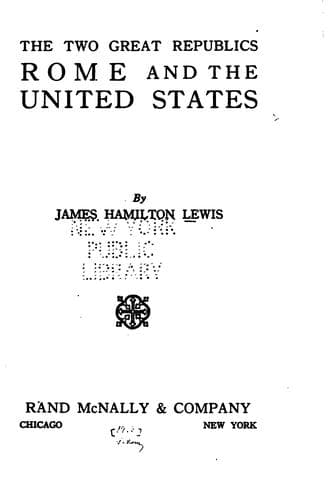
The Two Great Republics: Rome and the United StatesLewis, James
History
The Two Great Republics: Rome and the United States
Lewis, James
Rome -- Politics and government -- 510-30 B.C.; United States -- Politics and government
Few people are unaffected by the glamour of success. It is this
criterion alone which, as Thomas Moore writes, generally marks the
distinction between the patriot and the traitor.
"Rebellion! foul, dishonoring word,
Whose wrongful blight so oft has stained
The holiest cause that tongue or sword
Of mortal ever lost or gained.
How many a spirit, born to bless,
Hath sunk beneath that withering name,
Whom but a day's, an hour's success
Had wafted to eternal fame!
As exhalations, when they burst
From the warm earth, if chilled at first,
If checked in soaring from the plain,
Darken to fogs and sink again;--
But if they once triumphant spread
Their wings above the mountain-head,
Become enthroned in upper air,
And turn to sun-bright glories there!"
This success, so necessary to earn for the patriot or reformer the
fame to which he is so justly entitled, is too often able to win
admiration and respect also for the successful enemies of mankind.
Few members of the human race ever deserved less praise from posterity
(unless indeed, as a tribute to great but misdirected abilities) than
Julius Cæsar; but, nevertheless, many tributes have been laid before
the tomb of this destroyer of his country's liberties. For example,
the historian Mommsen, thus eulogizes Cæsar:
"Cæsar, from the outset and as it were by hereditary right
the head of the popular party, had for thirty years borne
aloft its banner without ever changing or even so much as
concealing his colors; he remained democrat even when
monarch. As he accepted without limitation, apart of course
from the preposterous projects of Catiline and Clodius, the
heritage of his party; as he displayed the bitterest, even
personal, hatred to the aristocracy and the genuine
aristocrats; and as he retained unchanged the essential
ideas of Roman democracy, viz., alleviation of the burdens
of debtors, transmarine colonization, gradual equalization
of the differences of rights among the classes belonging to
the State, emancipation of the executive power from the
Senate; his monarchy was so little at variance with
democracy, that democracy on the contrary only attained its
completion and fulfillment by means of that monarchy. For
his monarchy was not the Oriental despotism of divine right,
but a monarchy such as Gaius Gracchus wished to found, such
as Pericles and Cromwell founded--the representation of the
nation by the man in whom it puts supreme and unlimited
confidence. The ideas which lay at the foundation of Cæsar's
work were so far not strictly new; but to him belongs their
realization, which after all is everywhere the main matter;
and to him pertains the grandeur of execution, which would
probably have surprised the brilliant projector himself if
he could have seen it, and which has impressed, and will
Public-domain text, read in full here on John Shaqi.
Reviews
Reviews
No reviews yet
Be the first to share your thoughts on this work.
Elsewhere in the archive
Join the Discussion
Join the discussion
Sign in to leave a comment or review.
Sign InorCreate an account