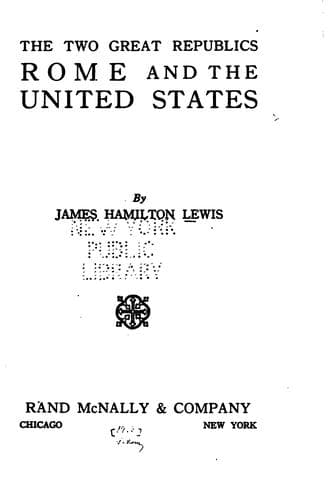
The Two Great Republics: Rome and the United StatesLewis, James
History
The Two Great Republics: Rome and the United States
Lewis, James
Rome -- Politics and government -- 510-30 B.C.; United States -- Politics and government
always impress, every one to whom it has been presented in
the living reality or in the mirror of history--to whatever
historical epoch or whatever shade of politics he may
belong--according to the measure of his ability to
comprehend human and historical greatness, with deep and
ever-deepening admiration."
The laudations of Cæsar, it is perhaps needless to say, are always
from men like Mommsen who are absolutely devoid of any true sympathy
for free government or popular rights. No more striking commentary on
such men can be found than from comparing Mommsen's attack upon the
revolutionary methods of Tiberius Gracchus with his defense of Cæsar,
given above.
The truth of the matter is that Cæsar was never at any time in his
career a sincere member of the popular party. The people were his
dupes, by whose aid he raised himself to the imperial power and
destroyed the political liberties of his native state. His almost
blasphemous use of the names of the great dead leaders and martyrs of
the popular cause as cloaks to cover his own selfish and unpatriotic
schemes is not the least of the indictments against him in the eyes of
the true advocate of popular rights. In such actions, however, Cæsar
does not stand alone. In our politics of to-day nothing is more common
for a politician than to try to cover his corruption by throwing over
himself the mantle of some great national hero. The cloak of Jefferson
in one political party, and of Lincoln in the other, are striven for
by men who desire to use them solely for the purpose of covering their
opposition to everything for which these men stood.
Nor has Cæsar been without imitators in every age, and in every
republic, who, if the opportunity would only permit, desire above all
else to imitate his life and success. The ability of Cæsar, however,
is seldom or never to be found in his imitators; but the ambition
itself is to be found somewhere among the politicians of every
republic. There is also generally a strong influential class that
would prefer the strong settled rule of one man to the constant
political controversies with "their unsettled effect upon business."
And the reality of a republic can always be destroyed without
affecting its form, as was done in Rome by the centering of the powers
of the different officials in Cæsar, or more recently, in Mexico, by
the many successive elections of Diaz to the presidency.
The early and violent death of Cæsar came before his plans were
completed, and before he had assumed the title, as well as the
authority, of a king or emperor. The ancient historian Appianus
Alexandrinus has left a vivid account of the closing scene of Cæsar's
life, some extracts from which are here inserted:
Public-domain text, read in full here on John Shaqi.
Reviews
Reviews
No reviews yet
Be the first to share your thoughts on this work.
Elsewhere in the archive
Join the Discussion
Join the discussion
Sign in to leave a comment or review.
Sign InorCreate an account