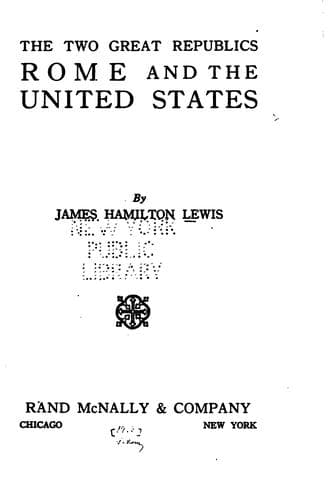
The Two Great Republics: Rome and the United StatesLewis, James
History
The Two Great Republics: Rome and the United States
Lewis, James
Rome -- Politics and government -- 510-30 B.C.; United States -- Politics and government
The history of Rome, therefore, cannot be so perverted as to teach the
lesson which some seem to draw from it, that the substitution of a
despotism for popular rule may, under some circumstances, be a
benefit to the community. It is never by the destruction of liberty
that the evils of popular rule can be eliminated. In the past, in the
present, and in the future, the only remedy for the evils of liberty
is more liberty; and the lesson which should be learned from the fall
of the Roman republic is that any country, where the privileged
classes are suffered to retain their unjust privileges at the expense
of the community, must in the end suffer some such terrible penalty as
that paid by Rome under the tyranny and misrule of the Roman empire.
CHAPTER XIII
THE COMPARISON
The comparisons between the history and problems of the Roman republic
and those of our own country have been sometimes directly referred to,
sometimes merely indicated, in the course of this book. While it is
hoped that the reader has been able to follow the train of ideas
suggested by the author, and to apply the lessons taught by the story
of the fall of the Roman republic to aid in the solution of the
American problems of to-day, it is thought advisable, in this final
chapter of the book, to combine and summarize the difficult problems
of economics, civics, and politics anticipated in Roman experience.
First of all comes the lesson, so often taught by Roman history, so
often already referred to in this book, that political equality is
never by itself sufficient to secure either the protection of the
weaker members of society or the general welfare of the community.
Political equality means nothing unless supplemented by laws which
secure economic justice.
The oft-repeated cry that politics and business should be kept
separate is the product of a shallow, unreasoning, or hypocritical
mind--generally the latter. This cry is the argument of the
stand-patter, of the man who trembles for the existence of the United
States Constitution and of American institutions when any proposal is
made to pass a law in the interests of the mass of the community, but
who can view with complacency the enactment of statutes for the
benefit of certain favored classes. Economic problems and special
privileges were among the greatest problems and dangers in the Roman
republic, as they are in America to-day.
Public-domain text, read in full here on John Shaqi.
Reviews
Reviews
No reviews yet
Be the first to share your thoughts on this work.
Elsewhere in the archive
Join the Discussion
Join the discussion
Sign in to leave a comment or review.
Sign InorCreate an account