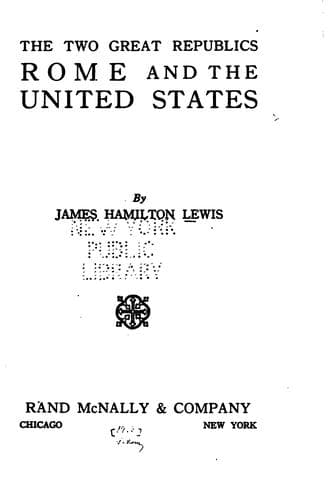
The Two Great Republics: Rome and the United StatesLewis, James
History
The Two Great Republics: Rome and the United States
Lewis, James
Rome -- Politics and government -- 510-30 B.C.; United States -- Politics and government
When we come to the exact form of the economic questions, differences,
of course, begin to appear. Tariffs, trusts, regulation of commerce,
were never great political questions in the days of the Roman
republic. The greatest source of scandal and class favoritism at Rome
was to be found in the management and distribution of the public
lands. This particular problem was one which our country, for nearly a
century of national existence, was able to handle, in the main, wisely
and honestly. The great body of that vast expanse of rich farming
land, which was once the greatest asset of the United States, was
disposed of to actual settlers, who have played an important part in
the development of our wonderful West. Recently, however, corruption
even along this line has begun to manifest itself in America. Passing
over the numerous charges of actual corruption which have been made,
it is to be regretted that the United States government has of late
shown a decided disposition to favor great interests rather than
ordinary individuals in the management of the public resources. An
extremely indefensible discrimination is to be found in the act of
July 1, 1902, which established the form of civil government for the
Philippine Islands. Section 15 of this act, in providing for the
management of the public lands, provided that no more than sixteen
hectares of such land can be disposed of to any one individual, while
a corporation may acquire as much as 1,024 hectares.
From the standpoint of pure governmental science the most interesting
comparison between Rome and the United States lies in the elaborate
and complicated system of checks and balances to be found in each
government. The framers of each system seem generally to have been
thinking more of securing perfect brakes than of installing sufficient
operating power. It is a mere hackneyed remark to say that the most
prominent characteristic of the work of the Federal Constitutional
Convention was the system of checks and balances it developed, while
this same principle was carried to such an extreme in the organization
of the Roman government that it almost seems strange to an outside
observer that at times the resisting power of the "brakes" did not
prove more powerful than the operating power of the government, with
the result of a total failure of all government, and chaos, or
anarchy.
The most interesting of the "checks" in the Roman government was the
veto power of the tribunes--interesting alike for its contemporary
importance at Rome, and perhaps even more so for the great and
strangely directed influence which it has had upon the later
development of governmental institutions throughout the world.
Public-domain text, read in full here on John Shaqi.
Reviews
Reviews
No reviews yet
Be the first to share your thoughts on this work.
Elsewhere in the archive
Join the Discussion
Join the discussion
Sign in to leave a comment or review.
Sign InorCreate an account