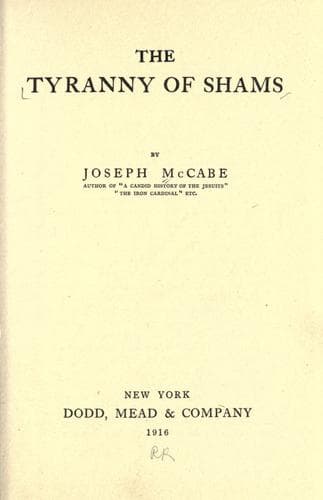
Great Britain -- Social conditions; Moral conditions; Social problems
I assume that, when we agree to direct our "Governments" to carry
out this elementary improvement of international life, they will
summon an international commission of philologists, educators, and
commercial men, whose business it will be to create a new language.
This step will not be taken until the voluntary movement for reform
has reached such proportions as to arouse the interest of politicians;
but in the end we rely on governmental action, as it is necessary to
reform schools and Parliaments. This international commission will, no
doubt, examine impartially such languages as Esperanto. Possibly these
existing international tongues will be found more complex than an
ideal language ought to be, and less attentive to the finer values of
speech. For the simple purpose of expression it is possible to create
a tongue far less complex than any in use in the civilised world
to-day: a tongue that could be learned in a few months even by the
untrained intelligence. It would proceed on the entirely opposite
principle to that of modern word-makers: the principle, for instance,
that changes "fireworks" into "pyrotechnics" (a piece of bad
Greek for good English), or "gardening" into "horticulture."
The use of this debased Latin and Greek in science has a certain
advantage under our present polyglot system, as it is an approach
toward international agreement, but it is making more onerous than
ever the burden of our languages. We want a simple means of expression
and intercourse, with a power of expanding to meet the advance of
thought and discovery without needing to run to such lengths as
"diaminotrihydroxydodecanoic acid." No existing national speech
would meet the purpose, least of all English; but it would be
advisable to have some regard to æsthetic interests in framing a new
language, and the old tongues would supply a good deal of material in
this regard. The success of the poet depends on qualities of words as
well as qualities of imagination, and we have no wish, like Plato, to
exclude poets from the ideal commonwealth. We should retain large
numbers of these short expressive words.
Great numbers of people hesitate in face of this proposal because they
feel that it is a very large innovation, however simple and
indisputable it is in principle. They contemplate such things as a
nervous child gazes on the sea from the steps of a bathing machine.
Intellectually, a few such plunges would be of incalculable service to
our generation. One can understand people hesitating before some
disputed economic or political scheme, but to shrink from adopting
plain and large reforms such as this is not a sign of health. We need
to purge our sluggish imaginations of their prejudices, to brace our
intellectual power, to take pride in our creativeness.
Public-domain text, read in full here on John Shaqi.
Reviews
Reviews
No reviews yet
Be the first to share your thoughts on this work.
Join the Discussion
Join the discussion
Sign in to leave a comment or review.
Sign InorCreate an account