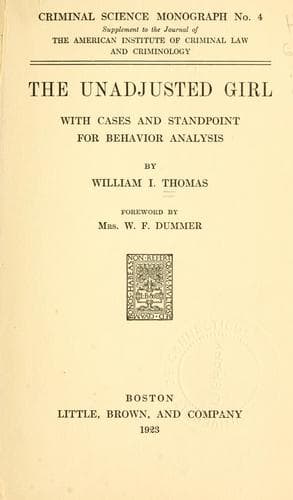
The Unadjusted Girl, With Cases and Standpoint for Behavior AnalysisThomas, William Isaac
Science
The Unadjusted Girl, With Cases and Standpoint for Behavior Analysis
Thomas, William Isaac
Female juvenile delinquents -- Case studies; Young women
In this case the social agency, the charity organization, takes the part
formerly played by the large family (kinship group) and the community.
The man in the case, the cause of the disorganization, is treated as
insane. Pretty certainly he would not have been insane in Europe, in his
original community. He would have been difficult, but the pressure of
the large family and the community would have kept him within certain
bounds. His violent behavior is also due in part to the fact that his
wife does not behave as a member of a community or family. She resorts
to American institutions, hales him into court and lands him in jail.
She must do this because she has no family and community back of her,
but she breaks the family solidarity. This and the fact that she
practices American freedom in associating with another man and receiving
presents from him make him “insane.” The wife in the European community
would not have taken such liberties; community gossip would have
restrained her.
On the other hand the woman never lost her ideal of a home, and the
coöperation of the charity organization enabled her to endure. The
removal of the man was a positive benefit. Further, the Irish Catholic
Church came into the case at a certain point and played the part of a
religious community. Its intervention gave aid, status, and recognition,
particularly to the girls. (The Polish Catholic Church in America always
exacts payment, and in general Polish organizations here interest
themselves only in those members who are worth while; the derelicts it
leaves to American institutions.)
Another saving element in the situation is that Mary was treated as a
member of a family, not as a transgressor against the State. She stole
repeatedly and forged checks, but she was never taken into court for it.
It was fortunately “overlooked”, as parents overlook such defections.
Mary was not betrayed sexually; she did not seem to be so disposed.
Perhaps she was lucky in this. Certainly she was fortunate in her
marriage, and through it became stabilized and an element of strength in
the larger family. Her sister Tillie has a better chance than Mary had.
But at the same time a review of the whole case leaves the feeling that
Mary’s future was never secure from the date of her birth to the date of
her marriage. There were not sufficient formative influences to assure a
social organization of her wishes.
Public-domain text, read in full here on John Shaqi.
Reviews
Reviews
No reviews yet
Be the first to share your thoughts on this work.
Elsewhere in the archive
Join the Discussion
Join the discussion
Sign in to leave a comment or review.
Sign InorCreate an account