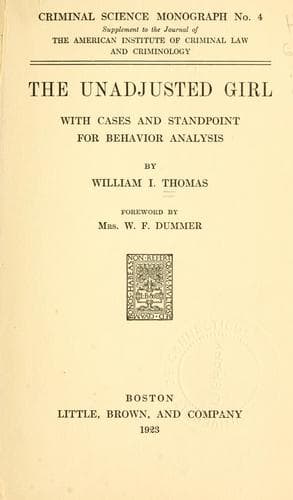
The Unadjusted Girl, With Cases and Standpoint for Behavior AnalysisThomas, William Isaac
Science
The Unadjusted Girl, With Cases and Standpoint for Behavior Analysis
Thomas, William Isaac
Female juvenile delinquents -- Case studies; Young women
If our public schools really educated, if they understood that education
involves a training of the instinctive and emotional life as well as of
the intellect, if they saw that they cannot even develop intellect as
long as they ignore desire, we should have an agency for adjusting the
neurotic girl and boy second only to the home in its power. There is
proof for this statement. Enlightenment is coming into education in
spots. There are visiting teachers who work on the problem children in a
school and get wonderful results. There are experimental schools whose
methods are based on an understanding of the new psychology as it
applies to educational theory. These schools are able to deal with the
able but neurotic child who cannot get along in the public school. Those
of us who work with difficult children are defeated constantly, not so
much by the impossibility of the cases, as by the impossibility of
finding any public school that understands or has time to act on its
understanding. I am constantly trying to straighten out the children the
public school can’t handle. Our school is not primarily educational but
is a place to observe and get acquainted with difficult, dependent, or
destitute children whom the various children’s agencies of Philadelphia
are trying to place satisfactorily in homes. They are children who do
not get along anywhere. Nobody wants them because they are so hard to
manage. The thing that constantly surprises us is how easy it is to
manage their behavior. They are not set like adults and a little
understanding, a little insight, and patience, a mere approach to real
educational methods gives immediate results that are almost like
magic.[107]
It is desirable that the school should eventually supersede the juvenile
court and replace other welfare agencies concerned with the child, but
in adapting itself to this task and to the task of general education it
will be compelled to make provision for the development of the emotional
and social life of the child as well as the informational, and in doing
this it will inevitably approach the model of El Retiro as described by
Doctor van Waters.
CHAPTER VI
THE MEASUREMENT OF SOCIAL INFLUENCE
In the last chapter we have seen the development of definite methods and
very positive successes, but everybody who deals with human beings
professionally—the educator, the criminologist, the statesman—feels that
he has no certain method for the control of behavior, that there are
obscure and incalculable elements, that the same procedure does not
secure the same results when applied to different individuals, that the
successes are often as unintelligible as the failures, and that such
successes as there are depend on common sense, personality, and trial
and error rather than on any known system of laws.
Public-domain text, read in full here on John Shaqi.
Reviews
Reviews
No reviews yet
Be the first to share your thoughts on this work.
Elsewhere in the archive
Join the Discussion
Join the discussion
Sign in to leave a comment or review.
Sign InorCreate an account