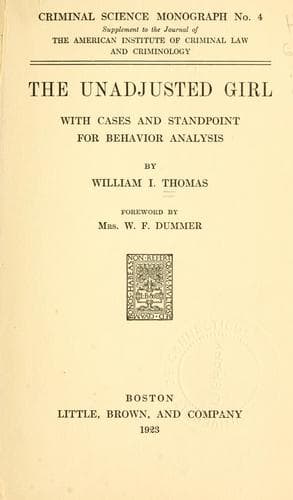
The Unadjusted Girl, With Cases and Standpoint for Behavior AnalysisThomas, William Isaac
Science
The Unadjusted Girl, With Cases and Standpoint for Behavior Analysis
Thomas, William Isaac
Female juvenile delinquents -- Case studies; Young women
For example, among the social sciences criminology has a larger amount
of concrete material bearing on behavior, more printed and unprinted
cases than any of the others. Certainly there is the strongest possible
motive for understanding the criminal and reforming him, and preventing
crime in general. But a recent appeal to the public by the President of
the American Institute of Criminal Law and Criminology for funds to
study the effects of criminal procedure indicates how far criminology is
from being a science:
... The institute asks that special inquiry be made of the wisdom and
success of probation, parole, indeterminate sentence and the entire
handling of criminals after conviction; that present acute differences
of opinion among equally public-spirited citizens be clarified and sound
conclusions reached as to the treatment of convicted criminals, neither
in the interests of sentimentality nor of vindictive vengeance, but for
the better protection of the public and the promotion of law and order.
The public may be shocked to know that no one now has facts to answer
the above inquiries.[108]
The whole criminal procedure is based on punishment and yet we do not
even know that punishment deters from crime. Or rather, we know that it
sometimes deters and sometimes stimulates to further crime, but we do
not know the conditions under which it acts in the one way or the other.
Similarly the most successful workers with delinquent children report
that sometimes their charges reform themselves spontaneously and, so to
speak, in spite of the efforts of the institution.
In analyzing the process of our successes among the so-called delinquent
girl two types are of special interest—those who “make good” without any
special kind of treatment, who get well by themselves, that is to say,
those who would have succeeded in any case; and second, those who have
succeeded by some accident, some course of the girl’s own that ran
counter to our wishes, our routine and our expectation; in short, those
who “make good” in spite of us.
Public-domain text, read in full here on John Shaqi.
Reviews
Reviews
No reviews yet
Be the first to share your thoughts on this work.
Elsewhere in the archive
Join the Discussion
Join the discussion
Sign in to leave a comment or review.
Sign InorCreate an account