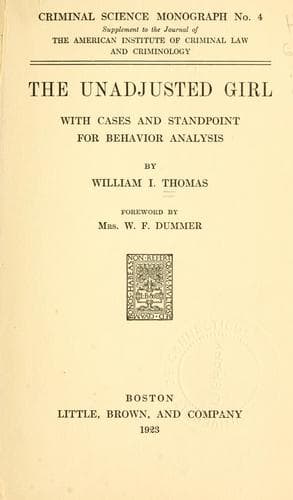
The Unadjusted Girl, With Cases and Standpoint for Behavior AnalysisThomas, William Isaac
Science
The Unadjusted Girl, With Cases and Standpoint for Behavior Analysis
Thomas, William Isaac
Female juvenile delinquents -- Case studies; Young women
The second type, those who unexpectedly make good by their own plan,
which is not of our making, is of profound sociological significance.
“We possess only that which we set free”, said an old Chinese
philosopher. How many of us know girls whom we have not set free, but
who have taken the bit in their teeth and run away from us, later to
emerge decently clothed, resourceful, industrious, successful and
adjusted to life beyond our fondest hopes. Recently I visited some
thirty state institutions for the training of delinquent girls. Most of
the superintendents reported stories of rebellion, escape, followed by
the inexplicable “making good.” Many commented on fortunate marriages
contracted because the girl strayed in forbidden paths, dancehalls,
piers, rinks, cafés and other loafing places of Prince Charming. We are
more familiar with this type of fortuitous success in boys than in
girls, boys who flee from us to navy, army or wild west. Many a candid
probation officer will tell you that she has met with it in girls.[109]
Detective Burns, speaking of the counterfeiter Wilken, says below
(document No. 92, p. 236): “I have often wondered whether his talents
would have been smothered by convention if he had been kept in the
straight and narrow path. The most commonplace man becomes sometimes the
most startlingly original crook. The reformed crook, on the other hand,
turns to honesty and becomes duller than ditch-water.”
In the paper quoted above as document No. 88, p. 200, Jessie Taft says:
The intimate psychological or psychiatric interpretation, the
individual intensive treatment, are fundamental for solving the
problems of delinquency. No matter how ideal the social conditions,
no matter how farsighted the laws, there will always be compensatory
behavior in the lives of individuals, and some of this behavior is
bound to be unwholesome and socially undesirable. Instinctive
protective reactions on the part of society, even the more
enlightened mass treatment in institution, will bring results only
by accident.
What we need is a treatment of behavior so scientific that results
instead of being accidental will be subject to intention and
prediction. Biology studies the life-history of individual forms and
explains any particular details of their behavior in the light of
the life of the organism as a whole from birth to death. Where does
a similar case study of human beings belong? Without it there can be
no scientific solution of the problems of delinquency.
Public-domain text, read in full here on John Shaqi.
Reviews
Reviews
No reviews yet
Be the first to share your thoughts on this work.
Elsewhere in the archive
Join the Discussion
Join the discussion
Sign in to leave a comment or review.
Sign InorCreate an account