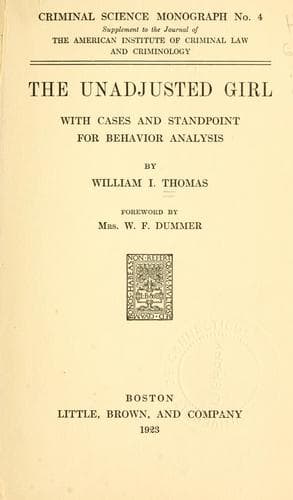
The Unadjusted Girl, With Cases and Standpoint for Behavior AnalysisThomas, William Isaac
Science
The Unadjusted Girl, With Cases and Standpoint for Behavior Analysis
Thomas, William Isaac
Female juvenile delinquents -- Case studies; Young women
Human experience and schemes of personal behavior are the most
interesting of all themes, as is evidenced by fiction, the drama,
biographies, and histories. And works of this kind contain materials
which will be given a scientific value as we analyze, compare, and
interpret them. Even fictitious representations are significant when
viewed as showing the tendency at a given moment to idealize certain
schematizations of life. The autobiography has a more positive value for
the student, but usually tends to approach the model of fiction,
idealizing certain situations and experiences and repressing others
totally. Incidentally one of the largest and most important bodies of
spontaneous material for the study of the personality and the wishes
passes through the mails. The letters of the Bedford girl, for example
(document No. 86, p. 172) appeal to me as the most significant document
in this volume, in spite of the fact that they relate to one incident
and cover a relatively short time. The short life-histories of
approximately six thousand Jews printed in the New York _Forward_, and
representing the effort to find new definitions of new situations on the
part of the million and a half Jewish immigrants in New York City, and
to some extent of the three million Jews in America, are a rich
contribution to the study of the wishes. These records, hidden from the
eye of the “_goi_” behind the Hebrew alphabet, have the intimacy and
naïveté of personal confessions.
Another type of behavior record is now being prepared by those social
workers, psychologists, and psychiatrists who have to handle the
problems of maladjustment in the courts, schools, and reformatories and
in private practice. Under the pressure of practical needs they have
already assumed the standpoint I have outlined and are studying the
evolution of personal life-organization and making the record as
complete as possible. They meet the individual at the point of some
crisis, some experience or breakdown calling for readjustment, but from
this point they work backward into the history of the case and follow
its development into the future. In the beginning they over-determined
the value of the psychometric test, because this was the only method
psychology had put in their hands, but at present the measurement of
intelligence is recognized as having a limited usefulness.
“Feeble-mindedness” is partly a classificatory term for those
personalities whose behavior we have not been able to conform to the
usual standards because of lack of knowledge and method. We shall not
know what conditions to call feeble-minded until we have determined the
limits of the social influences which we can apply. Certain social
workers are taking case after case pronounced subnormal by the
clinicists and developing in them activities which enable them to live
in a society where they could not live before, while a large proportion
of those now pursuing peaceful callings would be called morons if they
Public-domain text, read in full here on John Shaqi.
Reviews
Reviews
No reviews yet
Be the first to share your thoughts on this work.
Elsewhere in the archive
Join the Discussion
Join the discussion
Sign in to leave a comment or review.
Sign InorCreate an account