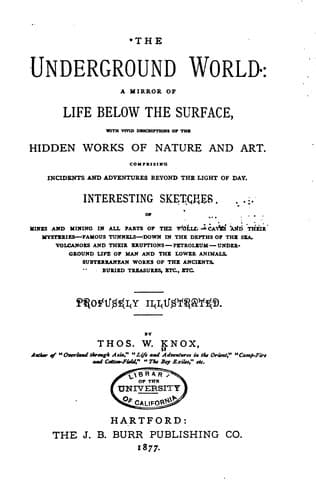
The Underground World: A mirror of life below the surfaceKnox, Thomas Wallace
History
The Underground World: A mirror of life below the surface
Knox, Thomas Wallace
Caves; Mines and mineral resources; Social history -- 19th century; Tunnels
The doctor, enthusiastic as he is with his new discoveries, had the
mortal remains of the immortal heroes taken from their graves, and the
great departed ones received the unprecedented honor to have their
portraits painted by an artist of our day. Of course, the golden mask
was used for that purpose.
The greatest scientific importance of the discoveries at Mycenæ,
lies in the fact that we now make acquaintance with a kind of art
which very nearly approaches oriental representation and oriental
technique. It can easily be seen, from the works of art found by the
excavations, that the artists of that remote time did not care so much
to give true representations of real existing things, but to procure
to dead things, as much as possible, a living, graceful form.
[Sidenote: GRECIAN ART IN MYCENÆ.]
Among the treasures, a golden plate was found, upon which Heracles
is engraved, struggling with a lion. This last engraving, above all
others, may serve as a scientific guide, through the labyrinth of the
treasures of Mycenæ. The struggles of Heracles with the monsters of
the earth, are the property of Grecian tradition; hence, we have not
to deal with Asiatic or India-European art, but with real, purely
Grecian art.
The most precious objects found at Mycenæ, are collected at Athens,
with those formerly found by the doctor among the treasures of
Priamus, and are preserved in the vaults of an Ionian bank.
It is proper that we should allude to Dr. Schliemann’s heroic wife,
of whom, as his most valuable and sympathetic assistant in his
labors, he speaks, as is most fitting, in words which constitute
her highest eulogy. The story of their union reads like a romance.
“Mrs. Schliemann is the only woman in Greece who knows the Odyssey by
heart.” The Dr. once said, before a party of Athenians, that he would
marry the first lady who could recite the Odyssey. A fair Greek girl
appeared one day, unintroduced, and asking if the promise was genuine,
recited Homer, and secured her home. She also secured a wife’s share
of $1,000,000. The two have been faithfully burrowing among its ruins
themselves, and as will be seen from the portrait, she is proud of the
accomplishments of her husband, and wears one of the trophies of his
glory, the head apparel of queen Helena, whose elopement with Paris,
the son of Priamus, caused the Trojan war.
[Sidenote: STATUARY AND ARCHITECTURE.]
Public-domain text, read in full here on John Shaqi.
Reviews
Reviews
No reviews yet
Be the first to share your thoughts on this work.
Elsewhere in the archive
Join the Discussion
Join the discussion
Sign in to leave a comment or review.
Sign InorCreate an account