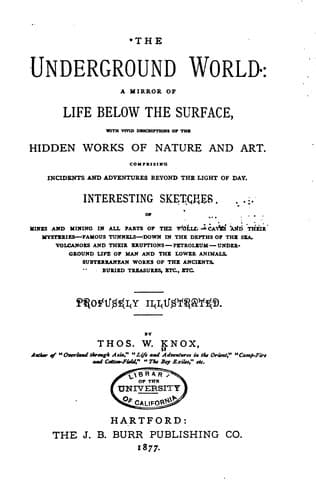
The Underground World: A mirror of life below the surfaceKnox, Thomas Wallace
History
The Underground World: A mirror of life below the surface
Knox, Thomas Wallace
Caves; Mines and mineral resources; Social history -- 19th century; Tunnels
The pyramid of Cheops, known as the Great Pyramid, was twenty years
in building, and it is said by Herodotus to have required the labor
of a hundred thousand men during that time. Cheops stopped all other
works connected with religious rites until the pyramid was completed.
To facilitate the transportation of stone from the Tourah quarries,
a causeway was built three thousand feet long, sixty feet wide, and
fifty feet high, which is said to have required ten years for its
completion. A railway engineer of the present day would have finished
this causeway in a month, provided he could have the unlimited supply
of laborers possessed by the Egyptian kings.
The Great Pyramid covers an area of between twelve and thirteen acres;
the side of its square measures seven hundred and forty-six feet, and
its height is four hundred and fifty feet. It was originally seven
hundred and sixty feet square and four hundred and eighty feet high;
its outer portions have been removed to furnish stone for building
purposes in Cairo. Originally, it was a perfect pyramid; the builders
began at the top and filled in, with small stone and cement, the
angles formed by the recession of each layer beyond the one below
it. Each side was thus left with an even surface sloping at an angle
of 51° 50´. The outer casing being removed has left the courses of
stone in the form of steps nearly four feet high, so that the ascent
is not an easy one. There are always plenty of Arabs hanging around
the pyramid ready to assist a traveller who wishes to ascend to the
summit. By pulling and pushing him over the steps, they get him up at
a reasonably rapid rate; but the exercise is of such a nature, that
it frequently leaves him feeling very much as if he had been passed
through a patent clothes wringer.
The pyramid contains about eighty-two millions of cubic feet of
masonry, and the total weight of the stone used in its construction
is estimated at more than six million tons. The entrance is on the
north face, fifty feet above the base, and about twenty-four feet from
the central line. The passage-way is low and narrow, and extends,
in a downward slope of twenty-six degrees, three hundred and twenty
feet to the sepulchral chamber. The chamber is forty-six feet long,
twenty-seven feet wide, and eleven feet high. There is a branch
passage-way leading from the main one, which terminates in a smaller
room, called the Queen’s Chamber; it is supposed that this room was
intended for the resting-place of the queen’s body, but it contains no
sarcophagus.
[Sidenote: THE KING’S CHAMBER.]
Public-domain text, read in full here on John Shaqi.
Reviews
Reviews
No reviews yet
Be the first to share your thoughts on this work.
Elsewhere in the archive
Join the Discussion
Join the discussion
Sign in to leave a comment or review.
Sign InorCreate an account