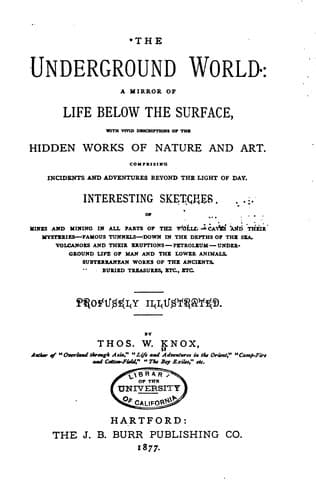
The Underground World: A mirror of life below the surfaceKnox, Thomas Wallace
History
The Underground World: A mirror of life below the surface
Knox, Thomas Wallace
Caves; Mines and mineral resources; Social history -- 19th century; Tunnels
An expedition starting in winter for a journey of ten days will carry
ten days’ supply of food for dogs and men. If the journey exceeds that
time, the allowance must be reduced; and sometimes the party will be
on the point of starvation. At the end of each day’s journey, it is
customary, if the party is to return by the same route, to conceal a
day’s supply of food, and thus lighten the load as much as possible.
There are several ways of making these deposits. The first requisite
is generally to protect the food against wild animals. Poles eight
or ten feet high are set upright, and a rude box is made at the top,
where the food can be placed. Wolves and foxes are the principal
four-footed thieves; they cannot climb, and therefore anything
protected in this way is safe from their depredations. Sometimes a
hole is made in the ground, and the deposit is placed within it. This
can only be safely done in winter, as the soft earth in summer can be
dug up by the enterprising and keen-scented animals with very little
trouble. A hole in winter can be made secure by pouring water over
the replaced earth, and allowing it to freeze. Wolves and foxes can
do many things, but they have not yet invented any way to dig through
frozen ground. They are wise enough not to attempt it, as they would
need a new set of paws every half hour if they followed digging in
frozen earth as a means of livelihood.
Baron Wrangell, Dr. Kane, and other arctic explorers, when travelling
on the ice of the Polar Sea, used to make holes in the bergs and
hummocks, and sometimes in the level ice, which frequently gets a
thickness of eight or ten feet. After they had made the deposit in a
hole of this sort, they would fit a block of ice as nearly as possible
to the opening. After inserting the block they poured water into the
interstices, and allowed it to freeze, so as to make the place as
solid and even as ever. This was a sufficient protection against small
animals, but not always against polar bears. These huge beasts would
scent out the food, and with their powerful claws they managed to dig
into the ice, and help themselves. Even if the food had been put into
strong boxes before it was deposited, the beasts did not seem to be
hindered in getting at it, as they would break the boxes as easily as
a rat would open an egg-shell. Dr. Kane once tried the plan of sealing
the food in sheet iron cans pointed at the ends. Sometimes the bears
tossed these cans a while, and then abandoned them but they generally
managed to throw them about with sufficient violence to break the
shell and reach the contents. A healthy and full-grown polar bear
is a powerful beast, and has no respect for the laws affecting the
ownership of property.
[Sidenote: HONEST ABORIGINALS.]
Public-domain text, read in full here on John Shaqi.
Reviews
Reviews
No reviews yet
Be the first to share your thoughts on this work.
Elsewhere in the archive
Join the Discussion
Join the discussion
Sign in to leave a comment or review.
Sign InorCreate an account