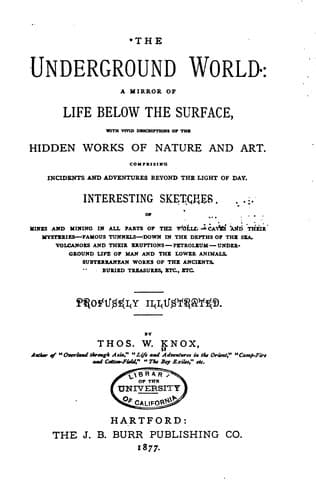
The Underground World: A mirror of life below the surfaceKnox, Thomas Wallace
History
The Underground World: A mirror of life below the surface
Knox, Thomas Wallace
Caves; Mines and mineral resources; Social history -- 19th century; Tunnels
In the extreme north deposits of food are in much greater danger from
four-footed beasts than from men. In the first place, the beasts
are much more numerous than men, and consequently want more to eat.
Men are not very likely, in those wild countries, to come near the
deposits, especially in arctic explorations; and even when they find
them they are not generally in the habit of stealing. The Esquimaux of
the region where Dr. Kane made his explorations are somewhat thievish
when they have the opportunity, but the natives of Northern Asia
have a high reputation for honesty. There are some tribes that have
never learned to steal; they have had very little intercourse with
white men, and are thoroughly uncivilized. As an illustration of this
barbarous honesty, I will give my own experience among the Koraks of
North-eastern Siberia.
My first acquaintance with them was on the shores of the Okhotsk Sea,
where they had assembled with their herds of reindeer. When we went
ashore we managed somehow to wet our blankets, and I hung mine up to
dry. I expressed my fears that the blankets would be stolen by some of
the Koraks, but was told that everything would be safe. When we camped
at night, my blankets were dry, and I slept in them. But I forgot the
blanket-straps, and there they hung in the open air all night, and all
the next day.
Now, it is a moral or an immoral certainty that a pair of leather
straps, new, and in good condition, in almost any other country would
have been taken in hand by somebody who couldn’t bear to see them
unused. But when I finally thought of my straps, I found them hanging
where I had left them thirty hours before, in full view of a dozen or
more natives, who were dressed in skins, and didn’t know anything more
about civilization and the customs of fashionable society than a horse
knows about running a sewing-machine.
[Sidenote: EXPERIENCE WITH A CACHE.]
On our western plains the custom of concealing articles in the
ground prevails over any other mode. The Indians have long practised
it, and they manage it so skilfully that it is next to impossible
to detect them. The early French settlers and explorers learned the
practice from the Indians, and the name they gave to a place of
concealment—“_cache_,” from _cacher_, to conceal—has been adopted into
the language of all plainsmen, of whatever nationality. So well is
this word known that many frontier Americans use it in preference to
words in their own language having the same meaning. A frontiers-man
will speak of finding a place where a squirrel had _cached_ a peck
of nuts, or will tell you that he _cached_ his bowie knife in his
boot-leg rather than carry it at his waist-belt.
Public-domain text, read in full here on John Shaqi.
Reviews
Reviews
No reviews yet
Be the first to share your thoughts on this work.
Elsewhere in the archive
Join the Discussion
Join the discussion
Sign in to leave a comment or review.
Sign InorCreate an account