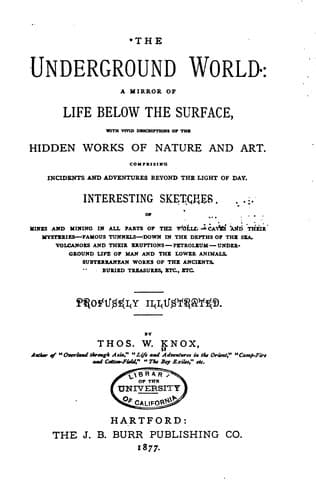
The Underground World: A mirror of life below the surfaceKnox, Thomas Wallace
History
The Underground World: A mirror of life below the surface
Knox, Thomas Wallace
Caves; Mines and mineral resources; Social history -- 19th century; Tunnels
My first acquaintance with a cache on the plains was in the vicinity
of Fort Kearney. Our party was camped near a half dozen men who were
returning from Salt Lake City, and had lost three of their oxen. We
struck up an acquaintance, and in the evening invited them to sit
around our fire, where we exchanged news and stories, they telling us
of Utah, and we telling them about the States or “God’s Country,” as
one of them called it. “Stranger,” said he, “if ever I get back to
God’s Country, and you catch me again on these yere plains, you may
just shoot me for a prairie dog. I’ve seen all I want of this yere
living, and don’t hanker for no more of it. I’m a going back where I
can have a square meal at a table, and drink whiskey that wouldn’t
burn a hole through an old boot in five minutes.”
We were not bountifully supplied with the necessaries of life, but
we felt liberal, and ventured to offer a drink of whiskey to each of
the strangers. They took it as unhesitatingly as a kitten would take
a saucer of new milk, and we became friends in a short time. When we
separated, one of the eastward-bound travellers said,—
“May be you’ll run short of flour before you get to the mountains,
and a little would help you along. Now, we had to lighten up just
this side of the Platte crossing, where we lost two of our oxen. We
couldn’t find anybody to sell to, and as we didn’t like to throw
things away altogether, we cached some of them. Next day we met a man
one of us knew, and we sold him all the caches but one, and told him
where to find them. But there was one bag of flour in a cache away
from the rest, and he didn’t want no flour; so we didn’t tell him
where it was.”
We offered to buy the flour, but the men would not listen to the
proposition.
“It’s Utah flour,” said one of them, “and isn’t very good. The sack
is small, and the whole lot wouldn’t be worth a great deal; but you
can’t buy it. You’ve treated us handsome, and we’re not going to be
rattlesnakes. We want you to take that flour, and you shan’t pay for
it.”
We thanked them heartily, and proffered another drink, which was
accepted and swallowed.
[Sidenote: HOW TO CONCEAL FLOUR.]
“About five miles this side of the old crossing of the Platte,” one of
the strangers continued, after wiping the drops of whiskey from his
lips, “you will come to a dry creek. There’s a small clump of willows
on your right hand, and mighty small willows they are too; and on the
left side, a dozen yards off the road, there are three buffalo heads
piled up, with a sage bush sticking in the top one. Now, you go up the
creek past these yere buffalo heads about fifty yards, and you’ll see
a grave with a little board at one end. On the board are some words
which we cut, that says, ‘J. MEANS, SALT LAKE, 34 YEARS.’ Now, there
ain’t no J. Means there, but there is a sack of flour, and you’ll find
it by digging.”
Public-domain text, read in full here on John Shaqi.
Reviews
Reviews
No reviews yet
Be the first to share your thoughts on this work.
Elsewhere in the archive
Join the Discussion
Join the discussion
Sign in to leave a comment or review.
Sign InorCreate an account