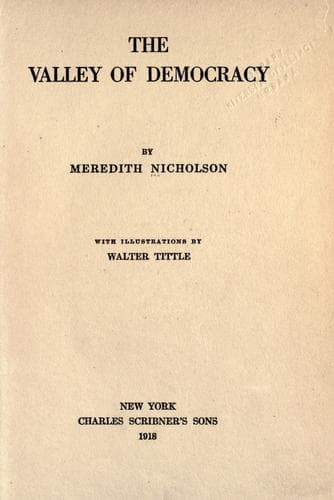
Mississippi River Valley -- Social life and customs
Are women less prone to snobbishness than men? Contrary to the
general opinion, I think they are. Their gentler natures shrink from
unkindness, from the petty cruelties of social differentiation which
may be made very poignant in a town of five or ten thousand people,
where one cannot pretend with any degree of plausibility that one does
not know one’s neighbor, or that the daughter of a section foreman or
the son of the second-best grocer did not sit beside one’s own Susan
or Thomas in the public school. The banker’s offspring may find the
children of the owner of the stave-factory or the planing-mill more
congenial associates than the children on the back streets; but when
the banker’s wife gives a birthday party for Susan the invitations are
not limited to the children of the immediate neighbors but include
every child in town who has the slightest claim upon her hospitality.
The point seems to be established that one may be poor and yet
be “nice”; and this is a very comforting philosophy and no mean
touchstone of social fitness. I may add that the mid-Western woman,
in spite of her strong individualism in domestic matters, is, broadly
speaking, fundamentally socialistic. She is the least bit uncomfortable
at the thought of inequalities of privilege and opportunity. Not long
ago I met in Chicago an old friend, a man who has added greatly to
an inherited fortune. To my inquiry as to what he was doing in town
he replied ruefully that he was going to buy his wife some clothes!
He explained that in her preoccupation with philanthropy and social
welfare she had grown not merely indifferent to the call of fashion,
but that she seriously questioned her right to adorn herself while
her less-favored sisters suffered for life’s necessities. This is an
extreme case, though I can from my personal acquaintance duplicate it
in half a dozen instances of women born to ease and able to command
luxury who very sincerely share this feeling.
IV
The social edifice is like a cabinet of file-boxes conveniently
arranged so that they may be drawn out and pondered by the curious. The
seeker of types is so prone to look for the eccentric, the fantastic
(and I am not without my interest in these varieties), which so
astonishingly repeat themselves, that he is likely to ignore the claims
of the normal, the real “folksy” bread-and-butter people who are, after
all, the mainstay of our democracy. They are not to be scornfully waved
aside as bourgeoisie, or prodded with such ironies as Arnold applied to
the middle class in England. They constitute the most interesting and
admirable of our social strata. There is nothing quite like them in any
other country; nowhere else have comfort, opportunity, and aspiration
produced the same combination.
Public-domain text, read in full here on John Shaqi.
Reviews
Reviews
No reviews yet
Be the first to share your thoughts on this work.
Join the Discussion
Join the discussion
Sign in to leave a comment or review.
Sign InorCreate an account