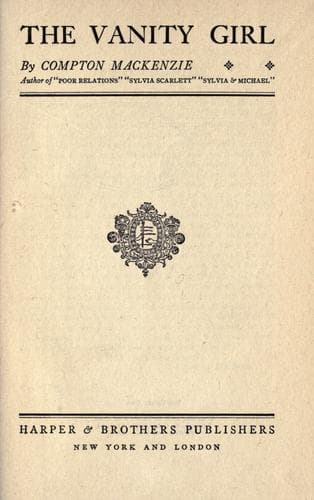
England -- Social life and customs -- 20th century -- Fiction; Social classes -- England -- Fiction
"Though, of course," continued the gentleman in the V-shaped waistcoat,
"with your appearance you oughtn't to have to bother much about anything
else."
This was very gratifying to Norah; even if there should be trouble when
she got home, the evening would have been worth while for this assurance
that her looks were capable of making an impression upon artistic
society.
"You really think I ought to go on the stage?" she asked, assuming the
manner of a person who for a long while has been trying to make up her
mind on this very point.
"Everybody ought to go on the stage," the gentleman in the V-shaped
waistcoat enthusiastically announced; "at least, of course, not
everybody, but certainly everybody who is obviously cut out for the
profession like you. But don't be in a hurry to make up your mind," he
added. "You're very young." He must have been nearly twenty-five
himself. "There's no need to hurry. I was driven to it."
Norah appeared interested and sympathetic. She really was rather
interested, because the idea had passed through her mind that Wilfred
might go on the stage. If this young man could earn seven pounds a week,
surely Wilfred, who was much better looking, could earn ten pounds a
week, in which case they might be married at once.
"What drove you to it?" she asked, and then blushed in confusion; being
driven to anything was associated in Norah's mind with drink, and she
thought the young man might be embarrassed by her question.
"Oh, a woman!" he replied, in a lofty tone. "But don't let's talk about
things that are past and over. Let's eat and drink to-day, for
to-morrow--Did you ever read Omar Khayyam? A man in our crowd introduced
me to him last year. I tell you, after Omar Khayyam Kipling isn't in it.
I suppose you read a good deal of poetry?"
"A good deal," Norah admitted. "At least, I used to read a good deal."
This was true; she had read several volumes at school under the menaces
of the literature mistress.
"Well, if I may offer you some advice," said the young man, "go on
reading poetry. I may as well confess right out that poetry has been my
salvation. Have some more of this shape? It's a little soft, but the
flavor's excellent." After supper Norah took Lily aside and told her she
must go home at once.
"But, Norah," protested the daughter of the flat, without being able to
conceal a slight inflection of scorn, "the evening's only just
beginning. Lots of people come in after supper always."
Norah resented Lily's tone of superiority; but inasmuch as this was her
first experiment in open defiance, she decided not to go too far this
time, especially as she was not quite sure how far her father's
unreasonableness might not extend.
"Cyril Vavasour will see you home," said Lily. "He's awfully gone on
you. He told me you were one of the most beautiful girls he'd ever met."
Public-domain text, read in full here on John Shaqi.
Reviews
Reviews
No reviews yet
Be the first to share your thoughts on this work.
Join the Discussion
Join the discussion
Sign in to leave a comment or review.
Sign InorCreate an account