As its reception showed immediately and has continued to show, the
_Origin_ benefited from the succinctness imposed by circumstances.
Darwin himself may have appreciated this point; at any rate, he never
produced the massive treatise, although he repeatedly issued revised
editions of the _ Origin._ But he did not abandon his intention to
buttress his initial schematic presentation with additional evidence.
In the course of the next two decades he published several full-length
elaborations of topics summarily discussed in the _Origin: The
Variation of Animals and Plants under Domestication; The Descent of
Man, and Selection in Relation to Sex;_ and _The Expression of the
Emotions in Man and Animals._ In addition to fleshing out the _Origin,_
these subsequent studies bolstered its arguments and responded to
questions raised by critical readers, especially pragmatic questions
about the way that descent with modification actually operated.
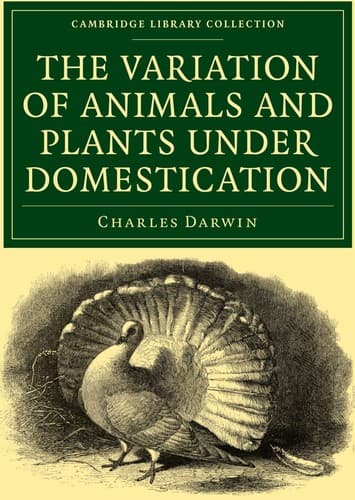
In _The Variation of Animals and Plants under Domestication,_ which
appeared first in 1868 and in a revised edition in 1875, Darwin
developed a theme to which he had accorded great rhetorical and
evidentiary significance. He had begun the _ Origin_ with a description
of artificial selection as practiced by farmers, stock breeders, and
pet fanciers, thus using a reassuringly homely example—one recognizable
by the general public as well as by members of the scientific
community—to introduce the most innovative component of his
evolutionary theory. In addition, domesticated animals and plants,
because they were numerous and available for constant observation,
provided a readily available body of evidence.
Reassuring as it was, the analogy between natural and artificial
selection was far from perfect. The point of Darwin’s analogy was to
make the idea of natural selection seem plausible by characterizing it
as a grander version of a well-known process while emphasizing its
efficiency and shaping power. He noted, for example, that some of the
prize birds bred by London pigeon fanciers diverged so strikingly in
size, plumage, beak shape, flying technique, vocalizations. bone
structure, and many other attributes, that if they had been presented
to an ornithologist as wild specimens, they would unquestionably have
been considered to represent distinct species, perhaps even distinct
genera. Darwin argued that if the relatively brief and constrained
selective efforts of human breeders had produced such impressive
results, it was likely that the more protracted and thorough-going
efforts of nature would work still more efficaciously.
Public-domain text, read in full here on John Shaqi.
Reviews
Reviews
No reviews yet
Be the first to share your thoughts on this work.
Join the Discussion
Join the discussion
Sign in to leave a comment or review.
Sign InorCreate an account