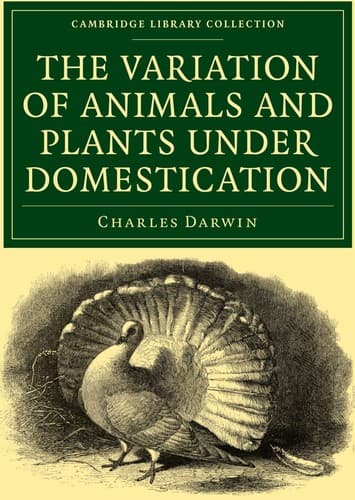
But as Darwin acknowledged, there were some fairly obvious reasons why
the two processes might diverge. The superior power of natural
selection—“Man can act only on external and visible characters: nature
. . . can act on . . . the whole machinery of life. Man selects only
for his own good; Nature only for that of the being which she tends”
(_Origin,_ chap. 5)—might constitute a difference of kind rather than
of degree, as might the much greater stretches of time available for
natural selection. Further, although the mechanism of the two processes
appeared superficially similar, their outcomes tended to be rather
different. Natural selection produced a constantly increasing and
diversifying variety of forms; it never reversed or exactly repeated
itself. Anyone familiar with artificial selection would have realized
that, although new breeds were constantly being developed and although
neither improved wheat nor improved cattle showed any tendency to
revert to the condition of their aboriginal wild ancestors, the strains
produced by human selection were neither as prolific nor as durable as
those produced by nature. Indeed, the animals and plants celebrated as
the noblest achievements of the breeder’s art were especially liable to
delicacy and infertility. Highly bred strains, long isolated from
others of their species to preserve their genealogical purity, far from
serving as a springboard for further variation, often had to be
revivified with infusions of less-rarefied blood. Yet any relaxation of
reproductive boundaries threatened subsidence into the common run of
conspecifics.
Darwin firmly connected _Variation_ to the _Origin_ by devoting its
introduction to an overview of his theory of evolution by natural
selection. In particular, the two volumes of _Variation,_ cumbersomely
organized and packed with zoological and botanical detail, addressed
some of the difficulties inherent in the attractive but paradoxical
analogy between natural selection and artificial selection. For
selection of any sort to operate, diversity already had to exist. With
wild populations living under natural conditions, however, diversity
was difficult to discern. It was widely believed that a heightened
propensity to vary (at least in ways obvious to human observers) was
one of the few general characteristics that differentiated domestic
animals as a group from their wild relatives. This point was
conventionally illustrated with reference to coat color and design.
American bison, for example, were, on the whole, brown, and all
Burchell’s zebras shared similar black and white stripes. A single herd
of either _Bos tauras_ or _Equus caballus_ (domestic cattle or horses),
on the other hand, could display colors ranging from white through
yellow, red, and brown to black, as well as a variety of spotted and
blotched patterns.
Public-domain text, read in full here on John Shaqi.
Reviews
Reviews
No reviews yet
Be the first to share your thoughts on this work.
Join the Discussion
Join the discussion
Sign in to leave a comment or review.
Sign InorCreate an account