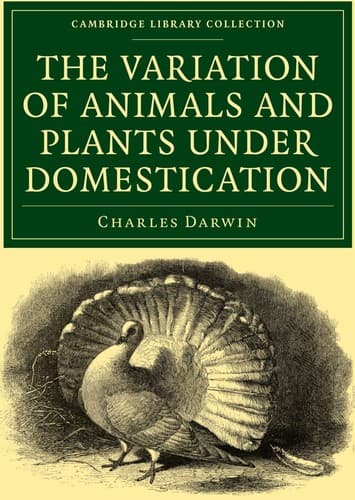
In order to demonstrate that such populations spontaneously produced
sufficient variation to support artificial selection, Darwin devoted
most of the first volume of _ Variation_ to a species-by-species survey
of domesticated plants and animals. He began with the dog, the breeds
of which differed so greatly in size, shape, disposition, talents, and
every other characteristic that Darwin attributed its exemplary
plasticity to its derivation from several different species of wild
canines. Domestic cats, on the other hand, differed relatively little
from one another, at least, their variation tended to be individual,
rather than consolidated into breeds. Darwin attributed this to the
minimal influence exerted by cat owners over the mating behavior of
their animals, so that, alone among fully domesticated animals, cats
could not be said to have undergone a genuine process of artificial
selection.
Farmyard ungulates, however, had all proved more susceptible to human
manipulation, whether through the gradual enhancement of inherent
tendencies, such as the relatively early maturation that distinguished
shorthorn cattle, or through the preservation of spontaneously arising
monstrosities, such as the short, broad foreheads and protruding lower
jaws of the niata cattle of South America, the bulldogs of the bovine
world. Among animals, fancy pigeons, with their short generations,
devoted breeders, and lack of any pragmatic constraints on their
extravagant deformations, provided Darwin with his most abundant
material. He allotted less space to his survey of domesticated plants,
although, with the exception of trees, they tended to he much shorter
lived and more variable even than pigeons. For example, as Darwin
pointed out, a single long-cultivated species—_Brassica oleracea,_ the
ordinary cabbage—had given rise to strains as distinctive as Brussels
sprouts, cauliflower, broccoli, and kohl-rabi.
Public-domain text, read in full here on John Shaqi.
Reviews
Reviews
No reviews yet
Be the first to share your thoughts on this work.
Join the Discussion
Join the discussion
Sign in to leave a comment or review.
Sign InorCreate an account