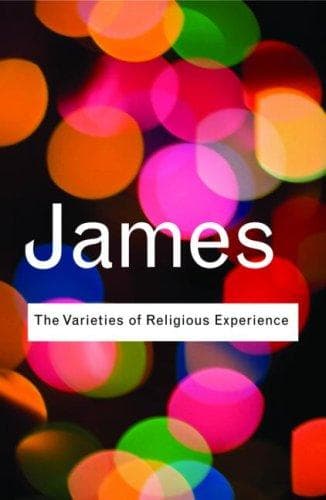
The Varieties of Religious Experience: A Study in Human NatureJames, William
ReligionComparative
The Varieties of Religious Experience: A Study in Human Nature
James, William
Conversion; Experience (Religion); Philosophy and religion; Psychology, Religious; Religion
At about the age of fifty, Tolstoy relates that he began to have moments
of perplexity, of what he calls arrest, as if he knew not “how to live,”
or what to do. It is obvious that these were moments in which the
excitement and interest which our functions naturally bring had ceased.
Life had been enchanting, it was now flat sober, more than sober, dead.
Things were meaningless whose meaning had always been self‐evident. The
questions “Why?” and “What next?” began to beset him more and more
frequently. At first it seemed as if such questions must be answerable,
and as if he could easily find the answers if he would take the time; but
as they ever became more urgent, he perceived that it was like those first
discomforts of a sick man, to which he pays but little attention till they
run into one continuous suffering, and then he realizes that what he took
for a passing disorder means the most momentous thing in the world for
him, means his death.
These questions “Why?” “Wherefore?” “What for?” found no response.
“I felt,” says Tolstoy, “that something had broken within me on
which my life had always rested, that I had nothing left to hold
on to, and that morally my life had stopped. An invincible force
impelled me to get rid of my existence, in one way or another. It
cannot be said exactly that I _wished_ to kill myself, for the
force which drew me away from life was fuller, more powerful, more
general than any mere desire. It was a force like my old
aspiration to live, only it impelled me in the opposite direction.
It was an aspiration of my whole being to get out of life.
“Behold me then, a man happy and in good health, hiding the rope
in order not to hang myself to the rafters of the room where every
night I went to sleep alone; behold me no longer going shooting,
lest I should yield to the too easy temptation of putting an end
to myself with my gun.
“I did not know what I wanted. I was afraid of life; I was driven
to leave it; and in spite of that I still hoped something from it.
“All this took place at a time when so far as all my outer
circumstances went, I ought to have been completely happy. I had a
good wife who loved me and whom I loved; good children and a large
property which was increasing with no pains taken on my part. I
was more respected by my kinsfolk and acquaintance than I had ever
been; I was loaded with praise by strangers; and without
exaggeration I could believe my name already famous. Moreover I
was neither insane nor ill. On the contrary, I possessed a
physical and mental strength which I have rarely met in persons of
my age. I could mow as well as the peasants, I could work with my
brain eight hours uninterruptedly and feel no bad effects.
Public-domain text, read in full here on John Shaqi.
Reviews
Reviews
No reviews yet
Be the first to share your thoughts on this work.
Elsewhere in the archive
Join the Discussion
Join the discussion
Sign in to leave a comment or review.
Sign InorCreate an account