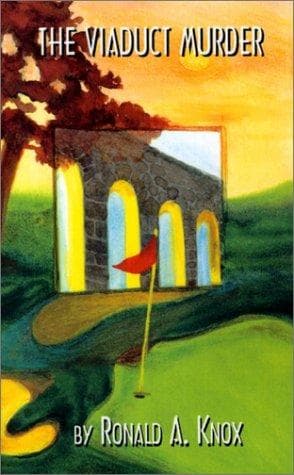
Detective and mystery stories; England -- Fiction; Murder -- Investigation -- Fiction
“I don’t think he meant to sleep the Tuesday night at the Hatcheries.
He had transferred his base somewhere else—to London, I suppose—and
his visit to Paston Whitchurch, on the pretext of picking up something
he had left behind, was merely meant to establish, in our eyes, the
fact that he was a different man from Brotherhood.”
“There’s one more thing, though,” said Marryatt; “I’m afraid it’s a
kind of professional objection. Is it possible that a man who was
really an atheist would be at the pains to go over every Sunday to
Mass at Paston Bridge? Davenant, you see, was very regular about that.
Or, granted that he was really a Catholic, could he bring himself to
get up and preach atheist doctrines on the village green?”
Carmichael pulled a wry face. “I’m afraid, Marryatt, you are
altogether too confiding. Don’t you see that he was a Catholic, and
was doing the work of his own Church by turning the villagers against
you and your doctrines? Don’t you see that if he managed to make
atheists of your people, it would be all the easier for the priest at
Paston Bridge to make Romans of them?”
“In fact,” said Gordon, “what it comes to is this: we have got to look
for a criminal still; but it’s no use looking for Davenant?”
“You would be chasing a phantom,” said Carmichael.
Chapter VIII
The Inquest, and a Fresh Clue
The inquest was held on the following afternoon (that is, the
afternoon of Thursday) in the village school at Paston Whitchurch. As
he sat waiting to give his evidence, Reeves found his mind dominated,
as the mind is dominated at such moments, almost entirely by
irrelevant sense-impressions. There was the curious smell of the
schoolroom, which always suggests (it is hard to know why) ink and
chalk. There was the irritating pant and hoot of motors and
motor-bicycles outside the open windows. There was the inevitable
series of animals represented round the walls, looking like the
religious emblems of some strange, totemistic worship. The one
opposite Reeves had a caption underneath it in very large letters, THE
PIG IS A MAMMAL, as if to clear up any possible doubts which might be
felt by the youth of the parish as to what a pig was. There were the
names cut and inked on the desks; especially intriguing was the
signature of “H. Precious”—how did people in the country get such odd
names? And why were there so few names like that in the London
Telephone Directory? Carmichael would probably have a theory about
this. . . .
Public-domain text, read in full here on John Shaqi.
Reviews
Reviews
No reviews yet
Be the first to share your thoughts on this work.
Join the Discussion
Join the discussion
Sign in to leave a comment or review.
Sign InorCreate an account