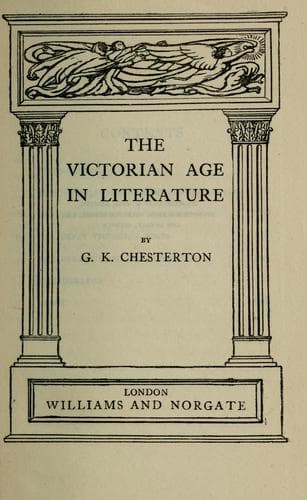
The Victorian Age in LiteratureChesterton, G. K. (Gilbert Keith)
History
The Victorian Age in Literature
Chesterton, G. K. (Gilbert Keith)
English literature -- 19th century -- History and criticism
The rise of Dickens is like the rising of a vast mob. This is not only
because his tales are indeed as crowded and populous as towns: for truly
it was not so much that Dickens appeared as that a hundred Dickens
characters appeared. It is also because he was the sort of man who has
the impersonal impetus of a mob: what Poe meant when he truly said that
popular rumour, if really spontaneous, was like the intuition of the
individual man of genius. Those who speak scornfully of the ignorance of
the mob do not err as to the fact itself; their error is in not seeing
that just as a crowd is comparatively ignorant, so a crowd is
comparatively innocent. It will have the old and human faults; but it is
not likely to specialise in the special faults of that particular
society: because the effort of the strong and successful in all ages is
to keep the poor out of society. If the higher castes have developed
some special moral beauty or grace, as they occasionally do (for
instance, mediæval chivalry), it is likely enough, of course, that the
mass of men will miss it. But if they have developed some perversion or
over-emphasis, as they much more often do (for instance, the Renaissance
poisoning), then it will be the tendency of the mass of men to miss that
too. The point might be put in many ways; you may say if you will that
the poor are always at the tail of the procession, and that whether they
are morally worse or better depends on whether humanity as a whole is
proceeding towards heaven or hell. When humanity is going to hell, the
poor are always nearest to heaven.
Public-domain text, read in full here on John Shaqi.
Reviews
Reviews
No reviews yet
Be the first to share your thoughts on this work.
Join the Discussion
Join the discussion
Sign in to leave a comment or review.
Sign InorCreate an account