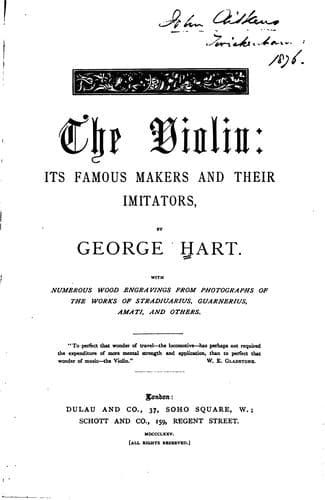
The Violin: Its Famous Makers and Their ImitatorsHart, George
History
The Violin: Its Famous Makers and Their Imitators
Hart, George
Violin -- History; Violin makers -- Biography
It is said that Sanscrit scholars have met with names for the bow in
Sanscrit writings dating back nearly two thousand years. If this
information could be supplemented by reliable monumental evidence of
the existence of a bow of some rude kind among the nations of the East
about the commencement of the Christian era, its value would
necessarily be complete. In the absence of such evidence we are left
in doubt as to what was intended to be understood by the reported
references to a bow in ancient Sanscrit literature. The difficulty of
understanding what Greek and Roman authors meant, in reference to the
same subject, must be greatly intensified in the works of ancient
Eastern writers.[4]
[Footnote 4: In the "Reflections" at the end of Vol. I., "Burney's
History of Music," we read, "The ancients had instead of a bow, the
Plectrum." "It appears too clumsy to produce from the strings tones
that had either the sweetness or brilliancy of such as are drawn from
them by means of the bow or quill. But, notwithstanding it is
represented so massive, I should rather suppose it to have been a
quill, or piece of ivory in imitation of one, than a stick or blunt
piece of wood or ivory."]
The inquiry is simplified from the point of view of a Violinist if we
reject all bow-progenitors but those which have been strung with
fibre, silk, hair, or other material, the properties of which would
permit of the production of sustained sounds. Implements less
developed belong to a separate order of sound-producing contrivances,
namely plectra, and may be described as permitting strumming by
striking in place of twanging or twitching the strings. The imperfect
knowledge we have of instruments of the Fiddle kind in Europe,
belonging to a period many centuries later than that we are now
considering, points to their having been struck or strummed, and not
bowed with a view to the sounds being sustained.
The oldest known representation of a contrivance or instrument upon
which a string is stretched with a peg to adjust its tension, is
probably that described by Dr. Burney as having been seen by him at
Rome on an Egyptian obelisk. In a notice of Claudius Ptolemeus, an
Egyptian, who wrote upon harmonic sounds about the middle of the
second century, we have an illustration of an instrument of a similar
character to that found on the obelisk above noticed.[5] In all
probability neither of these contrivances was intended to be used as a
musical instrument further than for scientific purposes, as a means of
testing the tension of strings and the division of the scale: in
short, they were monochords and dichords.
[Footnote 5: Sir John Hawkins' History.]
Public-domain text, read in full here on John Shaqi.
Reviews
Reviews
No reviews yet
Be the first to share your thoughts on this work.
Join the Discussion
Join the discussion
Sign in to leave a comment or review.
Sign InorCreate an account