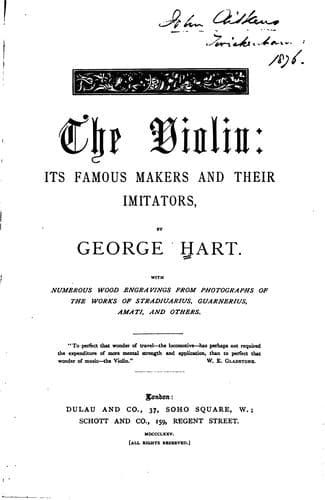
The Violin: Its Famous Makers and Their Imitators — John Shaqi
The Violin: Its Famous Makers and Their ImitatorsHart, George
History
The Violin: Its Famous Makers and Their Imitators
Hart, George
Violin -- History; Violin makers -- Biography
The parts Orpheus and Apollo have been made to play in infantile
Fiddle history have necessarily been dependent upon the licence and
the imagination of the sculptor and the medallist. Inferences of
antiquity, however, have been drawn from such representations.
Tracings of a bow among the sculpture of the ancients have been sought
for in vain: no piece is known upon which a bow is distinguishable. A
century since, an important discovery was thought to have been made by
musical antiquarians in the Grand Duke's Tribuna at Florence, wherein
was a small figure of Apollo playing on a kind of Violin with
something of the nature of a bow. Inquiry, however, made it clear that
the figure belonged to modern art. Orpheus has been represented
holding a Violin in one hand and a bow in the other; inquiry again
showed that the Violin and the bow were added by the restorer of the
statue.
The views held by musical historians regarding the origin of the
Violin may be described by the terms Asiatic and Scandinavian. The
Eastern view, it need scarcely be said, is the most prolonged,
exceeding some five thousand years along the vista of time, where
little else is discoverable but what is visionary, mythical, and
unsubstantial. It is related--traditionally of course--that some three
thousand years before our era there lived a King of Ceylon named
Ravanon,[2] who invented a four-stringed instrument played with a bow,
and which was named after the inventor "the Ravanastron." If it were
possible to identify the instrument of that name, now known to the
Hindoos, as identical with that of King Ravanon--as M. Sonnerat
declares it to be--the Eastern view of our subject would be singularly
clear and defined. A declaration, however, resting on tradition,
necessarily makes the gathering of evidence in support of it a task
both dubious and difficult.[3]
[Footnote 2: M. Sonnerat, "Voyage aux Indes Orientales," 1806.]
[Footnote 3: In Mr. Engel's "Researches into the Early History of the
Violin Family," 1883--a book containing much valuable evidence on the
subject--the author rightly remarks: "Now, this may be true; still it
is likewise true that most of the Asiatic nations are gifted with a
remarkably powerful imagination, which evidently induces them
sometimes to assign a fabulously high age to any antiquity of theirs
the origin of which dates back to a period where history merges in
myth. At the present day the Hindoos possess, among their numerous
rude instruments of the Fiddle class, an extraordinarily primitive
contrivance, which they believe to be the instrument invented by
Ravanon. Their opinion has actually been adopted by some of our modern
musical historians as if it were a well established truth."]
Public-domain text, read in full here on John Shaqi.
Reviews
Reviews
No reviews yet
Be the first to share your thoughts on this work.
Join the Discussion
Join the discussion
Sign in to leave a comment or review.
Sign InorCreate an account