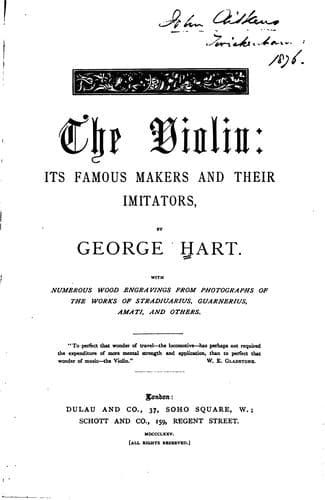
The Violin: Its Famous Makers and Their ImitatorsHart, George
History
The Violin: Its Famous Makers and Their Imitators
Hart, George
Violin -- History; Violin makers -- Biography
"Tho' mean thy rank, yet in thy humble cell,
Did gentle peace and arts unpurchased dwell.
Well pleased, Apollo thither led his train,
And Music warbled in her sweetest strain.
Cyllenius too, so fables tell, and Jove
Came willing guests to poor Philemon's grove.
Let useless pomp behold, and blush to find
So low a station, such a liberal mind."[3]
[Footnote 3: These verses were written by Mr. John Hughes, who was a
frequent performer on the Violin at Britton's concerts. (Hawkins.)]
Thus the first germ of the great musical societies gave a marked
impulse to the culture of stringed music in England. Attention was
turned to the subject; its humanising effects were recognised, and
parties met in several places for the practice of chamber music. Our
progress in Violin-playing at this date was clearly satisfactory. We
had a Violinist named John Henry Eccles, belonging to a clever family
of musicians. He became a member of the band of Louis XIV., and was
regarded as an excellent player and musician. He published in Paris
some solos for the Violin in 1720. His brother Thomas was also a good
Violinist. Fortune, however, did not smile upon him. He is described
as being one of those itinerant musicians--perhaps the last of
them--who in winter evenings went to taverns, and for a slender
subsistence bore the insults of those disinclined to listen to their
performance. This order of itinerant musicians may be described as
having descended from the Fiddling minstrels, whom the wealthy in
earlier times often retained in their houses, giving them coats and
badges bearing the family arms. These musicians, in place of amusing
the nobility, ultimately attended wakes and fairs. They were sometimes
retained at the large inns, where the guest while eating, an old
English writer says, was "offered music, which he may freely take or
refuse, and if he be solitary the musicians will give him the good
day, with music in the morning." In Puritan times this class of
musician was thought to have so much increased as to need a special
act for their suppression, which gave rise to Butler's creation, the
"Champion Crowdero." Returning to our subject with Thomas Eccles, we
have the following interesting account of the unfortunate Violinist,
by a musician: "It was about the month of November, 1753, that I, with
some friends, were met to spend the evening at a tavern in the City,
when this man, in a mean but decent garb, was introduced to us by the
waiter; immediately upon opening the door I heard the twang of one of
his strings from under his coat, which was accompanied by the
question, 'Gentlemen, will you please to hear my music?' Our
curiosity, and the modesty of the man's deportment, inclined us to say
yes, and music he gave us, such as I had never heard before, nor shall
again under the same circumstances. With as fine and delicate a hand
as I ever heard, he played the whole fifth and ninth solos of Corelli,
and two songs of Mr.
Public-domain text, read in full here on John Shaqi.
Reviews
Reviews
No reviews yet
Be the first to share your thoughts on this work.
Elsewhere in the archive
Join the Discussion
Join the discussion
Sign in to leave a comment or review.
Sign InorCreate an account