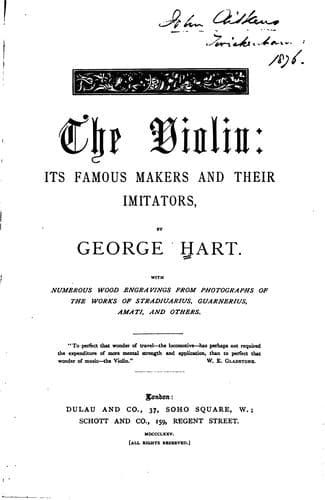
The Violin: Its Famous Makers and Their ImitatorsHart, George
History
The Violin: Its Famous Makers and Their Imitators
Hart, George
Violin -- History; Violin makers -- Biography
this view of the derivation of the word appears both ingenious and
correct. Roger North shrewdly conjectured that the "rude and gross"
Gothic Fiddle "used to stir up the vulgar to dancing, or perhaps to
solemnise their idolatrous sacrifices." In the Dark Ages dancing may
have been regarded as bi-pedal trembling. I have remarked in another
place,[19] "In the early ages of mankind dancing or jigging must have
been done to the sound of the voice, next to that of the pipe, and,
when the bow was discovered, to that of a stringed instrument which
was named the Geige from its primary association with dancing." The
evidence we have of the use to which the leading instrument was put in
the days of its adolescence is indicative of its having grown up among
dancers, jugglers, and buffoons. In Germany its players gave fame and
name to a distinct class of itinerant minstrels named the Gigeours,
who were often associated with the Jongleurs in their perambulations.
In France, from the days of the Jongleurs to those of Henry IV., and
later to those of Louis XIV., the instrument was wedded to the dance.
In England to the time of Charles II. it was in the hands of the
Fiddler, who accompanied the jig, the hornpipe, the round, and the
North Country frisk.
[Footnote 15: In Carl Engel's "Researches into the Early History of
the Violin Family," 1883, the author disbelieves in the Crwth having
been the lineal ancestor of the Violin, and there can be but little
doubt of the correctness of his opinion.]
[Footnote 16: It is worthy of remark that the Northmen, who invaded
and gave their name to Normandy, carried from their Scandinavian homes
a love of minstrelsy.]
[Footnote 17: Sebastian Wirdung, a priest, published a work in 1511,
in which he describes the bow instruments of his time by the names
Gross-Geigen and Klein-Geigen. The illustration of the Klein-Geige
differs but little from the Rebec; it has three strings, whilst the
Gross-Geige has nine. Further information is supplied by the work of
Martin Agricola, published in 1529.--_Mendel's German Musical
Dictionary, article "Violine."_]
[Footnote 18: "Almost all our musical writers state, as if it were a
well-ascertained fact, that the German word Geige is derived from the
_Gigue_ of the French Minstrels, who, during the 13th and 14th
centuries, had a sort of _Rebec_ which they called by that name, and
which, according to some commentators, resembled in outward appearance
the shank of a goat or ram, called _Gigot_, and hence the origin of
all the similar words occurring in different European languages. These
commentators have, however, neglected to prove that the old French
word Gigue occurs before the 13th century, or that it is earlier than
the Middle High German _Gige_."--_Engel's "Researches into the History
of the Violin Family."_]
[Footnote 19: "The Violin and its Music," 1881, page 19.]
Public-domain text, read in full here on John Shaqi.
Reviews
Reviews
No reviews yet
Be the first to share your thoughts on this work.
Join the Discussion
Join the discussion
Sign in to leave a comment or review.
Sign InorCreate an account