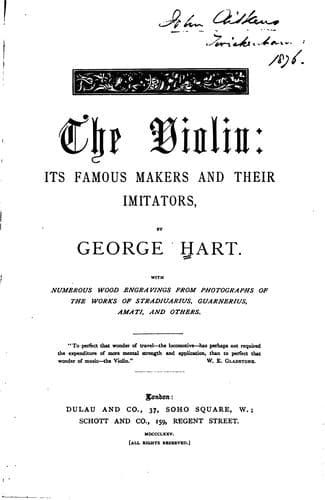
The Violin: Its Famous Makers and Their ImitatorsHart, George
History
The Violin: Its Famous Makers and Their Imitators
Hart, George
Violin -- History; Violin makers -- Biography
In pursuing the course of our subject, our inquiries have hitherto
been mainly concerned with the leading instrument in a barbarous and
semi-barbarous state. We now reach what may be termed the transition
stage of the question. The information relative to the appearance of
the Geige, or Violin tuned in fifths, is of the slenderest kind. To
obtain evidence of much worth it is necessary to reflect upon the
condition of instrumental music about the sixteenth century, together
with the form and character of bowed instruments belonging to the same
period. The manners and customs of peoples have also to be considered.
We have hitherto found the Geige or Fiddle among minstrels and
itinerant musicians in countries where music and minstrelsy had become
an institution with the people. The instrument was rude and gross, and
its office was to play extemporaneous accompaniments, with
considerable licence. At length domestic music began to be zealously
cultivated in Germany and the Low Countries, to which important
circumstance the rapid development of stringed instruments is
traceable. Viols of various kinds supported the voices, and an
important manufacture of such instruments took root in Nuremberg and
other German cities. In following the history of the Madrigal much
light is thrown upon that of the Viol, to which it is necessary to
give attention in order to follow in some degree the development of
the Violin.
The condition of music in Italy previous to the time when the father
of the Madrigal, Adrian Willaert, followed in the steps of his
countrymen and made Italy his home, presents a great contrast to the
state of the art in Germany and the Netherlands about the same period.
The love of music in these countries had been growing among the
people from the days of their minstrel poets and their wandering
musicians. In Italy minstrelsy received but little attention or
encouragement. The effect of this was probably felt when that
extraordinary love of culture and admiration for art manifested itself
amid the courts of her princes, about the middle of the fifteenth
century. The love of melody then, as now, was deeply rooted in the
nature of her people. Musical composition, however, of a high order,
and able executants, were to be found elsewhere, and in Flanders in
particular, and there the principal music and musicians were sought by
the Italian _dilettanti_. To this fortuitous combination of melody and
musical learning we owe the greatest achievements in the art of music.
Upon it was raised the work of Palestrina, Scarlatti, and Corelli,
which their distinguished followers utilised with such judgment and
effect. The progress and development of the Madrigal in Italy may be
said to have been co-equal with that of the Viol, for which its music
served, and to which the Italians gave the same beauty of form and
exquisite refinement. The ingenuity and skilfulness of the early
German Viol makers was not less speedily recognised by the Italians
Public-domain text, read in full here on John Shaqi.
Reviews
Reviews
No reviews yet
Be the first to share your thoughts on this work.
Join the Discussion
Join the discussion
Sign in to leave a comment or review.
Sign InorCreate an account