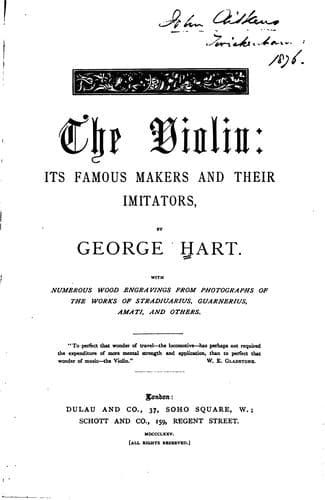
The Violin: Its Famous Makers and Their ImitatorsHart, George
History
The Violin: Its Famous Makers and Their Imitators
Hart, George
Violin -- History; Violin makers -- Biography
than was the learning and power manifested by the Flemish motet
writers. The work of the Italians with regard to both the Madrigal and
the Viol was artistic in the highest degree, and such as could alone
have been accomplished by men nourished on the teachings of the
Renaissance, and surrounded by its chief glories.
There is evidence of German influence over the Italian Viol
manufacture at the end of the fifteenth century, in the
German-sounding names of makers located in Italy, and likewise in the
character and construction of the oldest Italian Viols: notably, there
is the crescent-shaped sound-hole common to the German Grosse-Geige
and Klein-Geige. The most ancient Viols in existence are those by
Hieronymus Brensius of Bologna, two of which are in the Museum of the
Academy of Music at Bologna, and a third is in my possession. They
have labels printed in Roman letters, and doubtless belong to the end
of the fifteenth century. These instruments serve to illustrate the
condition of the art of Viol-making in Italy at that period. They are
rude in form and workmanship, and present a marked contrast to the
high artistic work associated with the Italians in other branches of
industry. This rudeness is indicative of this particular manufacture
being of recent importation, and of its having been received from
Germany, and partly perhaps from the Low Countries, where instrumental
music was cultivated chiefly by the people, in which case utility
would naturally have priority of design and workmanship. With the
introduction of Viols, in connection with the Madrigal, into the
palaces of Italy, together with their increased use in connection with
the service of the Church, a demand speedily arose for instruments of
elegant design and finished workmanship, in keeping with the high
standard raised by Italian artists in every direction. The work on the
Viol by Silvestro Ganassi, published at Venice in 1543, furnishes us
with ample proof of the advance made by the Italians in Viol-making
since Brensius worked. We see from a representation of a Viol in the
above-mentioned work that the sound-holes are better formed, the
scroll is artistically designed, and the whole harmonious. These steps
towards perfection were mounted by Duiffoprugcar and Gasparo da Salo,
both of whom rapidly developed the art. With Gasparo da Salo, or a
contemporary, was witnessed the rejection of the crescent-formed
sound-hole, and the adoption of that which has held its own for
upwards of three centuries. The sound-holes of the Amati and of
Stradivari are but those of Gasparo and his contemporaries, marked
with their own individuality. All Viols until about 1520 were
furnished with pieces of gut tied round the neck and fingerboard to
mark the divisions of the scale--in short, were fretted. From the work
of Ganassi we learn that the use of these divisions was optional, thus
supplying us with authentic information of considerable value with
Public-domain text, read in full here on John Shaqi.
Reviews
Reviews
No reviews yet
Be the first to share your thoughts on this work.
Join the Discussion
Join the discussion
Sign in to leave a comment or review.
Sign InorCreate an account