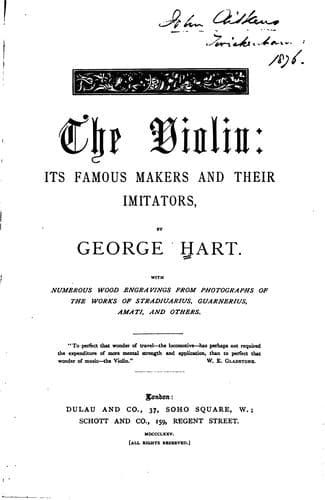
The Violin: Its Famous Makers and Their ImitatorsHart, George
History
The Violin: Its Famous Makers and Their Imitators
Hart, George
Violin -- History; Violin makers -- Biography
This mode of cutting is constantly met with in the works of the
Brescian makers, and likewise in those of the early Cremonese. Andrea
Amati invariably adopted this form. Stradivari rarely cut his wood
slab-form. Joseph Guarneri made a few Violins of his best epoch with
this cutting, the varnish on which is of an exquisite orange colour,
so transparent that the curls of the wood beneath resemble richly
illuminated clouds.
There can be no doubt whatever that the Cremonese and Brescian makers
were exceedingly choice in the selection of their material, and their
discrimination in this particular does not appear to have risen so
much from a regard to the beauty as to the acoustic properties of the
wood, to which they very properly gave the first place in their
consideration. We have evidence of much weight upon this interesting
question in the frequent piecings found on the works of Cremona
makers, pointing to a seeming preference on their part to retain a
piece of wood of known acoustic properties rather than to work in a
larger or better preserved portion at the probable expense of tone.
The time and care required for such a delicate operation must have
been sufficient to have enabled the maker, had he been so minded, to
have made a complete instrument. There is also ample proof that Joseph
Guarneri possessed wood to the exceptional qualities of which he was
fully alive, and the same may be said of Stradivari, Ruggeri, and
others. It is scarcely reasonable to suppose that in the seventeenth
century there was a dearth in Italy of timber suitable for the
manufacture of Violins, and that in consequence these eminent makers
were compelled to patch and join their material to suit their purpose.
They were men who were in the enjoyment of a patronage certainly
sufficient to enable them to follow their calling without privation of
any kind. Scarcity of pine and sycamore, good or bad, could not have
been the cause, since we find Italian cabinet-work of great beauty
that was manufactured at this same period. The plane-tree and pine
used by the Amati, Stradivari, and the chief masters in Italy, was
usually of foreign growth, and was taken from the Tyrol and Istria.
Its value was, therefore, in advance of Italian wood, but hardly so
much as to place it beyond the reach of the Cremonese masters. It is,
further, improbable that these masters of the art should have expended
such marvellous care and toil over their work, pieced as it frequently
was like mosaic, when for a trifling sum they could have avoided such
a task to their ingenuity by purchasing fresh wood. We are therefore
forced to admit that there must have been some cause of great weight
which induced them to apply so much time and labour, and that the
problem can only be accounted for by the solution before proposed,
viz., that external appearance was of less importance than the
possession of acoustic properties thoroughly adapted to the old
Public-domain text, read in full here on John Shaqi.
Reviews
Reviews
No reviews yet
Be the first to share your thoughts on this work.
Join the Discussion
Join the discussion
Sign in to leave a comment or review.
Sign InorCreate an account