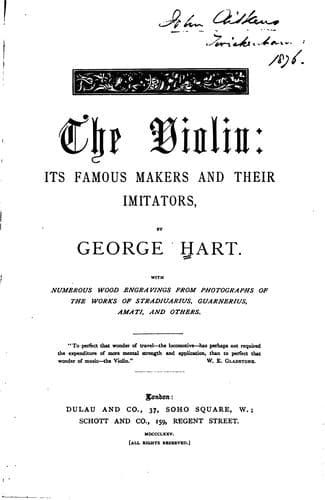
The Violin: Its Famous Makers and Their ImitatorsHart, George
History
The Violin: Its Famous Makers and Their Imitators
Hart, George
Violin -- History; Violin makers -- Biography
makers' purpose, and that the scarcity of suitable wood was such as to
make them hoard and make use of every particle. The selection of
material was hence considered to be of prime importance by these
makers; and by careful study they brought it to a state of great
perfection. The knowledge they gained of this vital branch of their
art is enveloped in a similar obscurity to that which conceals their
famous varnish, and in these branches of Violin manufacture rests the
secret of the Italian success, and until it is rediscovered the
Cremonese will remain unequalled in the manufacture of Violins.
We may now pass to the consideration of the various constituent parts
of a Violin. It will be found, if a Violin be taken to pieces, that it
is constructed of no less than fifty-eight separate parts, an
astonishing number of factors for so small and simple-looking an
instrument. The back is made of maple or sycamore, in one or two
parts; the belly of the finest quality of Swiss pine, and from a piece
usually divided; the sides, like the back, of maple, in six pieces,
bent to the required form by means of a heated iron; the linings,
which are used to secure the back and belly to the sides, are twelve
in number, sometimes made of lime-tree, but also of pine. The bass or
sound-bar is of pine, placed under the left foot of the bridge in a
slightly oblique position, in order to facilitate the vibrating by
giving about the same position as the line of the strings. The
divergence is usually one-twelfth of an inch, throughout its entire
length of ten inches. It is curious to discover that this system of
placing the bar was adopted by Brensius of Bologna, a Viol-maker of
the fifteenth century, and by Gasparo da Salo. The later
Violin-makers, however, for the most part, do not appear to have
followed the example, they having placed it in a straight line, thus
leaving the system to be re-discovered. The bar of the Violin not only
serves the purpose of strengthening the instrument in that part where
the pressure of the bridge is greatest, but forms a portion of the
structure at once curious and deeply interesting; it may indeed be
called the nervous system of the Violin, so exquisitely sensitive is
it to external touch. The slightest alteration in its position will
effect such changes in the tone as often to make a good Violin
worthless. Those troublesome notes technically known as "wolf notes"
by its delicate adjustment are sometimes removed, or passed to
intervals where the disagreeable sound is felt with less intensity.
Numerous attempts have been made to reduce these features to a
philosophy, but the realisation of the coveted discovery appears as
distant as ever. The most minute variation in the construction of the
instrument necessitates a different treatment of this active agent as
regards its conjunction with the bridge; and when it is considered
that scarcely two Violins can be found of exactly identical structure,
Public-domain text, read in full here on John Shaqi.
Reviews
Reviews
No reviews yet
Be the first to share your thoughts on this work.
Join the Discussion
Join the discussion
Sign in to leave a comment or review.
Sign InorCreate an account