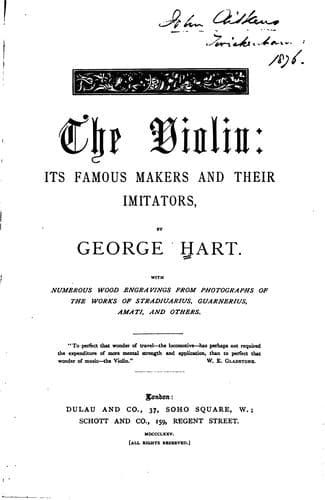
The Violin: Its Famous Makers and Their ImitatorsHart, George
History
The Violin: Its Famous Makers and Their Imitators
Hart, George
Violin -- History; Violin makers -- Biography
The next important feature to be mentioned is the bridge, which forms
no small part of the vibrating mechanism of the instrument, and needs
the utmost skill in its arrangement. Its usual position is exactly
between the two small niches marked in each sound-hole, but this
arrangement is sometimes altered in the case of the stop being longer
or shorter. Many forms of bridges have been in use at different
periods, but that now adopted is, without doubt, the best. In
selecting a bridge great care is requisite that the wood be suitable
to the constitution of the Violin. If the instrument is wanting in
brilliancy, a bridge having solidity of fibre is necessary; if wanting
in mellowness, one possessing soft qualities should be selected.
We now pass to the neck of the Violin, which is made of sycamore or
plane-tree. Its length has been increased since the days of the great
Italian masters, who seem to have paid but little attention to this
portion of the instrument, in regard to its appearance and as to the
wood used for its manufacture, which was of the plainest description.
It may be observed that in those times the florid passages which we
now hear in Violin music were in their infancy, the first and second
positions being those chiefly used; hence the little attention paid to
the handle of the instrument. Modern requirements have made it
imperative that the neck should be well shaped, neither too flat nor
too round, but of a happy medium. The difficulties of execution are
sensibly lessened when due attention is paid to this requirement.
The finger-board is of ebony, and varies a little in length according
to the position of the sound-holes. To form the board properly is a
delicate operation, for if it be not carefully made the strings jar
against it, and the movements of the bow are impeded. The nut, or
rest, is that small piece of ebony over which the strings pass on the
finger-board.
The purfling is composed of three strips of lime-tree, two of which
are stained black. Whalebone purfling has been frequently used,
particularly by the old Amsterdam makers.
Public-domain text, read in full here on John Shaqi.
Reviews
Reviews
No reviews yet
Be the first to share your thoughts on this work.
Join the Discussion
Join the discussion
Sign in to leave a comment or review.
Sign InorCreate an account