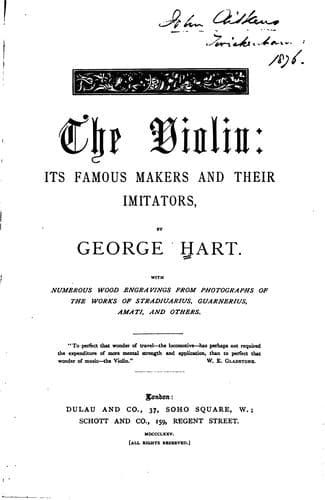
The Violin: Its Famous Makers and Their ImitatorsHart, George
History
The Violin: Its Famous Makers and Their Imitators
Hart, George
Violin -- History; Violin makers -- Biography
The principal parts of the instrument have now been described, and
there remain only the pegs, blocks, strings, and tail-piece, the sum
of which makes up the number of fifty-eight constituent parts as
before mentioned. There is still, however, one item of the
construction to be mentioned which does not form a separate portion of
the Violin, but which is certainly worthy of notice, viz., the button,
which is that small piece of wood against which the heel of the neck
rests. The difficulty of making this apparently insignificant piece
can only be understood by those who have gone through the various
stages of Violin manufacture. The amount of finish given to the button
affects in a great measure the whole instrument, and if there is any
defect of style it is sure to be apparent here. It is a prominent
feature, and the eye naturally rests upon it: as the key-stone to the
arch, so is the button to the Violin.
The sound-holes, or _f_-holes, it is almost needless to remark, are
features of vital importance. Upon the form given to them, and the
manner of cutting them, largely depend the volume and quality of tone.
The Italian makers of Brescia and Cremona appear to have been aware of
the singular influence the formation of the sound-hole has upon the
production and quality of sound. The variety of original shapes they
gave to them is evidence of their knowledge. Appearance in keeping
with the outline of their design may have influenced them in some
measure, but not entirely. Most makers used patterns from which to cut
their sound-holes; Joseph Guarneri and some others appear to have
drawn them on the belly, and cut them accordingly.
From the foregoing remarks upon the various portions of the Violin it
may be assumed that the reader has gained sufficient insight into the
process of its manufacture to enable him to dispense with a more
minute description of each stage.
In conclusion, I cannot refrain from cautioning possessors of good
instruments against entrusting them into the barbaric hands of
pretended repairers, who endeavour to persuade them into the belief
that it is necessary to do this, that, and the other for their
benefit. The quack doctors of the Violin are legion--they are found in
every town and city, ready to prey upon the credulity of the lovers of
Fiddles, and the injury they inflict on their helpless patients is
frequently irreparable. Unfortunately, amateurs are often prone to be
continually unsettling their instruments by trying different bars,
sound-posts, &c., without considering the danger they run of damaging
their property instead of improving it. Should your instrument need
any alteration, no matter how slight, consult only those who have made
the subject a special study. There are a few such men to be found in
the chief cities of Europe, men whose love for the instrument is of
such a nature that it would not permit them to recommend alterations
prejudicial to its well-being.
SECTION III
Italian and other Strings
Public-domain text, read in full here on John Shaqi.
Reviews
Reviews
No reviews yet
Be the first to share your thoughts on this work.
Join the Discussion
Join the discussion
Sign in to leave a comment or review.
Sign InorCreate an account