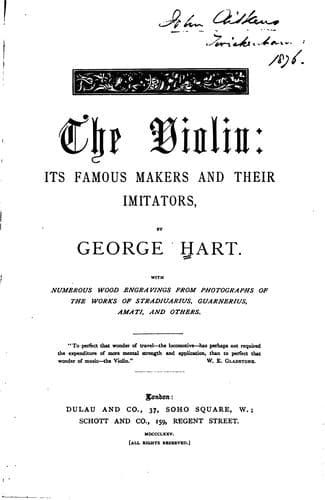
The Violin: Its Famous Makers and Their ImitatorsHart, George
History
The Violin: Its Famous Makers and Their Imitators
Hart, George
Violin -- History; Violin makers -- Biography
among the old musical writers in reference to the subject of strings,
we find Doni says in his musical treatise, published in 1647: "There
are many particulars relating to the construction of instruments which
are unknown to modern artificers, as, namely, that the best strings
are made when the north and the worst when the south wind blows," a
truism well understood by experienced string manufacturers. Thomas
Mace, in his curious book on the Lute, enters at some length into the
question of strings, and speaks in glowing terms of his _Venetian
Catlins_. The above references to strings, met with in the writers of
the sixteenth and seventeenth centuries, indicate a full knowledge of
the most important facts concerning them on the part of the musicians
and makers of those days; and notwithstanding our superior mechanical
contrivances in the manufacture, it is doubtful whether modern strings
are generally equal to those made in times when leisure waited on
quality, in lieu of speed on quantity.
[Footnote 1: Fetis, in his notice of Le Roy, states that the first
edition of this rare book was published in 1557, and was translated by
J. Alford into English in 1568.]
[Illustration: Hands testing strings.]
Musical strings are manufactured in Italy, Germany, France, and
England. The Italians rank first, as in past times, in this
manufacture, their proficiency being evident in the three chief
requisites for string, viz., high finish, great durability, and purity
of sound. There are manufactories at Rome, Naples, Padua, and Verona,
the separate characteristics of which are definitely marked in their
produce. Those strings which are manufactured at Rome are exceedingly
hard and brilliant, and exhibit a slight roughness of finish. The
Neapolitan samples are smoother and softer than the Roman, and also
whiter in appearance. Those of Padua are highly polished and durable,
but frequently false. The Veronese strings are softer than the Paduan,
and deeper in colour. The variations described are distinct, and the
more remarkable that all the four kinds are produced by one and the
same nation; as, however, the raw material is identical throughout
Italy, the process of manufacture must be looked upon as the real
cause of the difference noticed. The German strings now rank next to
the Italian, Saxony being the seat of manufacture. They may be
described as very white and smooth, the better kinds being very
durable. Their chief fault arises from their being over-bleached, and
hence faulty in sound. The French take the third place in the
manufacture. Their strings are carefully made, and those of the larger
sizes answer well; but the smaller strings are wanting in durability.
The English manufacture all qualities, but chiefly the cheaper kinds;
they are durable, but unevenly made, and have a dark appearance.
Public-domain text, read in full here on John Shaqi.
Reviews
Reviews
No reviews yet
Be the first to share your thoughts on this work.
Join the Discussion
Join the discussion
Sign in to leave a comment or review.
Sign InorCreate an account